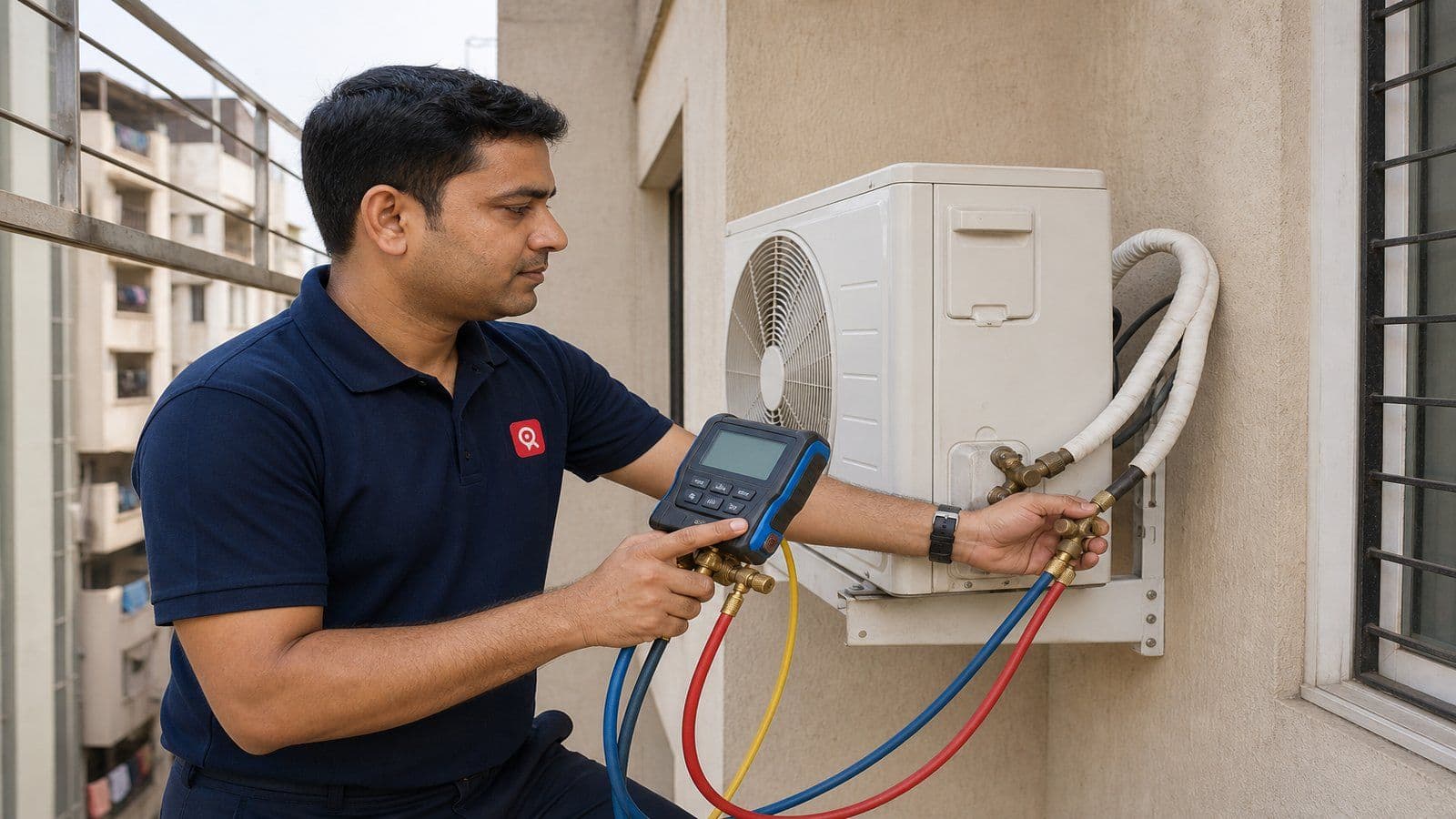
- The ProNearMe verified AC technicians in our network report that 64 percent of paid installation. calls for a 1.5 ton split AC in 2026 land between ₹4,500 and ₹9,500 inclusive of materials, labour and GST in tier-1 metros.
- The "free installation" offer that ships with most online and showroom AC purchases routinely excludes. copper pipe beyond 3 metres, the bracket, drainage extension and wall-drilling, which together add ₹3,500 or more on the install day.
- Copper pipe is the single most-overpaid line item, ask the per-metre rate by gauge (1/4",. 3/8", 1/2", 5/8") in writing before the technician arrives, not after the wall is open.
- A BIS IS 1391-compliant install adds 15 to 25 percent to the upfront bill but. reduces five-year repair and AMC spend by 30 to 40 percent in our network's repeat-customer data.
- GST at 18 percent applies on both labour and materials. Insist on a single itemised invoice with the GSTIN, the per-metre copper rate, bracket type and labour line shown separately.
The headline price on a new split AC is rarely the price you actually pay. The AC installation cost added on top, copper pipe per metre, the bracket, the drain run, the wall sleeve, the dedicated MCB and the labour itself, routinely lands between ₹4,500 and ₹9,500 for a typical 1.5 ton split inside an Indian metro. For window units the install bill sits lower.
For cassette or commercial setups it climbs significantly higher. This guide breaks down every line item that genuinely belongs on a 2026 installation invoice, with the price ranges our ProNearMe network of verified AC technicians records week after week across Mumbai, Pune, Bengaluru, Hyderabad and Delhi NCR.
The Bureau of Energy Efficiency (BEE) and the Bureau of Indian Standards (BIS) both highlight a recurring pattern in field data, the installation step is where most chronic AC problems are seeded. Undersized copper pipe, missing insulation, an under-rated bracket, a shared electrical circuit or a drain laid with reverse slope produce repair bills three to six years later that would never have appeared had the install been done to BIS IS 1391.
The cost ranges below are residential figures, GST treatment is noted where it matters, and reflect the realities of the 2026 copper, refrigerant and labour markets. For the full installation walkthrough, see our pillar guide on the AC installation complete guide for Indian homes.

Get quotes from top-rated pros.
Service-Call, Survey and Pre-Install Charges
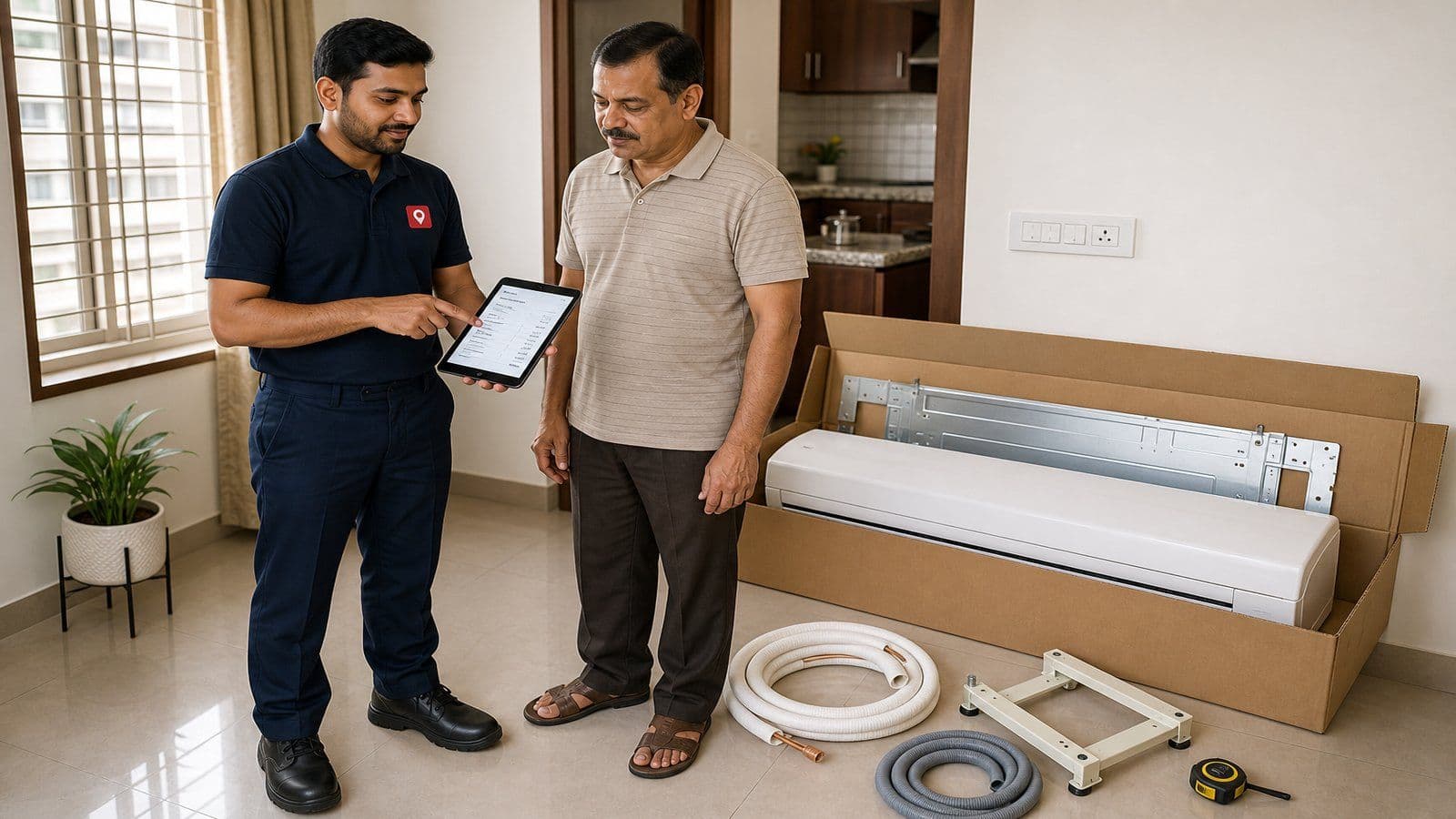
Photo: ProNearMe AC installer presenting itemised installation quote on a tablet
Almost every legitimate AC installation in India begins with a pre-install survey. In 2026 the standard range across our network sits at ₹0 to ₹500 for the visit. Brand authorised installers usually waive the survey fee against the installation bill. NSDC-certified independents charge ₹250 to ₹500 and adjust it against the final bill. Local unverified technicians often advertise "free survey" which usually means the cost is rebuilt into the per-metre pipe rate later.
A proper survey takes 25 to 40 minutes and should cover four things, the indoor unit wall location and stud check, the outdoor unit ledge or balcony spot, the cable and pipe run path including any drilling, and the electrical circuit. If a technician offers to install on the same call without measuring the pipe run or checking the MCB rating, the install will almost certainly throw up surprise add-ons mid-job. The Department of Consumer Affairs has flagged this pattern repeatedly through Jago Grahak Jago advisories.
Why the Survey Step Matters More on Modern Inverter Units
Inverter AC units draw a sharper instantaneous current at start-up than fixed-speed units of the same tonnage. Sharing a circuit with a geyser, microwave or refrigerator triggers nuisance MCB tripping that the homeowner later misreads as an AC fault. The Central Electricity Authority (CEA) wiring guidelines for domestic installations recommend a dedicated 16 amp C-curve MCB for any AC above 1 ton, and the survey is where that gap gets caught. Catching it before install costs ₹450 to ₹850 for the MCB and 15 minutes of electrician time. Catching it after install means re-routing cable through a finished wall.
Labour Charges by AC Type
These are the bread-and-butter installation labour figures across our network in 2026. They cover the on-site technician time only, with copper pipe, bracket, drain, electrical and incidentals quoted separately.
| Installation Job | Labour Range (2026) | Typical Duration |
| Standard split AC install, 1 to 1.5 ton | ₹1,500 to ₹2,800 | 90 to 150 minutes |
| Standard split AC install, 2 ton | ₹1,800 to ₹3,200 | 120 to 180 minutes |
| Window AC install | ₹800 to ₹1,500 | 45 to 90 minutes |
| Cassette AC install (commercial) | ₹3,500 to ₹7,500 | 4 to 6 hours, 2-person crew |
| Ductable split install | ₹4,500 to ₹9,500 | 6 to 8 hours, 2-person crew |
| Cross-floor or high-rise premium | +20 to 35 percent | Adds 30 to 60 minutes |
| Same-day or emergency install | +40 to 60 percent | No change |
The cross-floor premium is straightforward, longer pipe runs, scaffolding or rope-access for the outdoor unit, and material handling between floors. The high-rise premium kicks in above the eighth floor in most metros because outdoor unit placement frequently needs an external bracket installed by a roped technician, and society approval paperwork adds wait time on site.
The same-day emergency premium is most visible from April through June, when peak summer demand collides with limited certified-technician supply. Booking a planned install in February or March costs the same as off-season pricing and avoids both the premium and the multi-day wait.
Most homeowners only ask about labour and treat materials as 'whatever the technician brings'. That gets the order exactly backwards. Labour is the most fixed line on the bill. Copper pipe, bracket grade and the MCB are where the 30 to 50 percent variance sits. Insisting on a written rate card for materials BEFORE the install day, with copper per-metre by gauge and bracket grade specified, is the single biggest lever to cut the final invoice without compromising the install.

Copper Pipe Cost by Gauge
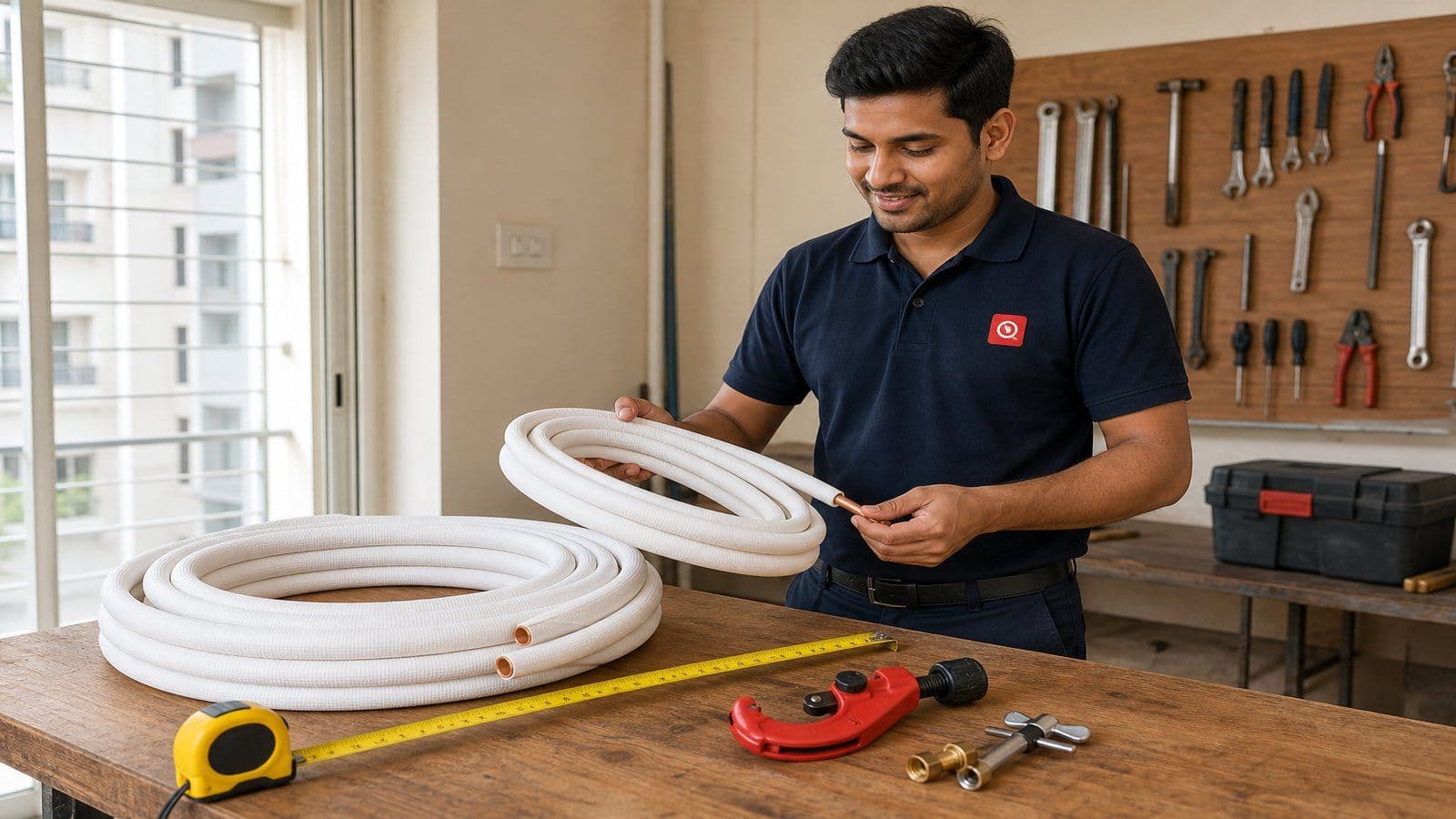
Photo: Close-up of insulated refrigeration copper pipe coils by gauge
Copper pipe is the largest single materials line on most split AC installations and the most consistently overpaid. Three things matter, the gauge (diameter), the wall thickness, and the insulation grade. The BIS Indian Standard for refrigeration copper tube specifies the minimum wall thickness, and the per-metre price difference between BIS-compliant tube and the thinner aftermarket variant is small (₹40 to ₹80) but the longevity difference is years.
Get quotes from top-rated pros.
| Pipe Size (OD) | Typical Use | Cost per Metre 2026 |
| 1/4 inch (6.35 mm) | Suction line, 1 ton split | ₹350 to ₹450 |
| 3/8 inch (9.52 mm) | Liquid or suction line, 1.5 ton split | ₹520 to ₹680 |
| 1/2 inch (12.7 mm) | Suction line, 1.5 to 2 ton split | ₹680 to ₹850 |
| 5/8 inch (15.88 mm) | Suction line, 2 ton and above | ₹920 to ₹1,100 |
A typical 1.5 ton split needs a 3/8" liquid line plus a 1/2" suction line in a 3 to 5 metre run. At the upper-mid of the per-metre band that comes to roughly ₹4,000 to ₹6,000 of copper alone on a 4-metre run before insulation. If your quote says "₹350 per metre, all sizes", it is almost certainly 1/4" tube being used where 1/2" is required, which constricts refrigerant flow and forces the compressor to work harder for the full life of the unit.
Insulation and Outer Wrap
The copper pipe must be insulated end to end. The 2026 standard is 6 mm nitrile rubber insulation at ₹85 to ₹140 per metre. A UV-resistant outer wrap protects exposed sections from sunlight on the balcony or outdoor route, ₹45 to ₹75 per metre. Skipping or under-specifying the insulation is the single most common cause of "AC dripping water inside the wall" calls 18 months later. A 4-metre run with proper insulation and UV wrap adds ₹520 to ₹860 to the bill, which is real money but cheaper than re-opening the wall.
Bracket, Drain, Sleeve and Incidental Materials
These are the smaller line items that collectively shift the total install bill by ₹1,500 to ₹3,500. They are also the items most commonly missing from a "free installation" quote.
| Item | Cost Range 2026 | Notes |
| Drain pipe, 16 mm PVC per metre | ₹35 to ₹55 | Standard length 3 to 5 metres |
| Wall sleeve plus grommet | ₹250 to ₹450 | Single sleeve, one drilling |
| Indoor unit back plate plus screws | Included | Ships with most ACs |
| Bracket, MS angle, 1.5 ton | ₹650 to ₹950 | Basic, suitable for ground floor or covered ledge |
| Bracket, powder-coated MS, 1.5 ton | ₹1,100 to ₹1,650 | Standard for most metros, 3 to 5 year rust life |
| Bracket, GI sheet, 1.5 ton | ₹1,800 to ₹2,400 | Recommended for coastal, 7 to 10 year corrosion life |
| Vibration mount set | ₹150 to ₹350 | Reduces noise transmission to wall |
Bracket Grade and Why It Matters
In coastal cities (Mumbai, Chennai, Kochi, Visakhapatnam, Mangaluru, Puri), MS angle brackets show visible rust within two summers and structural fatigue within three. The Indian Society of Heating, Refrigerating and Air Conditioning Engineers (ISHRAE) recommends GI sheet or powder-coated MS for any outdoor installation in coastal salt air. The ₹650 to ₹950 saved on the cheapest bracket frequently becomes a ₹3,500 emergency bracket replacement when the unit starts swaying in monsoon wind two summers later.
In tier-1 metros and tier-2 inland cities, powder-coated MS at ₹1,100 to ₹1,650 is the default safe choice for most homes. Insist on the powder-coat finish specifically, not unpainted MS sold as "industrial grade".
Electrical Requirements and Cost
Electrical work is the line item homeowners most often dismiss as "the technician's problem". That dismissal accounts for a meaningful share of the AC fault calls our network records in the first eighteen months after install.
| Component | Cost Range 2026 |
| Dedicated 16 amp C-curve MCB | ₹450 to ₹850 |
| Earth wire, 4 mm² per metre | ₹65 to ₹95 |
| Grommet plus cable gland | ₹85 to ₹150 |
| Electrical socket upgrade to 16 amp dedicated | ₹800 to ₹2,500 |
The CEA wiring guideline is clear, any AC above 1 ton on a shared 6 amp circuit will eventually trip the MCB on start-up surge. The fix at install time is a dedicated 16 amp MCB and a 4 mm² earth wire run to the AC outdoor unit. The total electrical add-on for most apartments lands at ₹600 to ₹1,500, which is small money for a permanent fix.
For older buildings where the entire distribution board needs upgrading to accommodate a dedicated AC circuit, budget ₹2,500 to ₹5,500 for a licensed electrician to add the breaker and run the cable. This is one-time cost and should be done before the AC technician arrives, not during the install window.
Regional Cost Variance Across India
Installation cost is not uniform across the country. Three patterns repeat consistently across our network data.
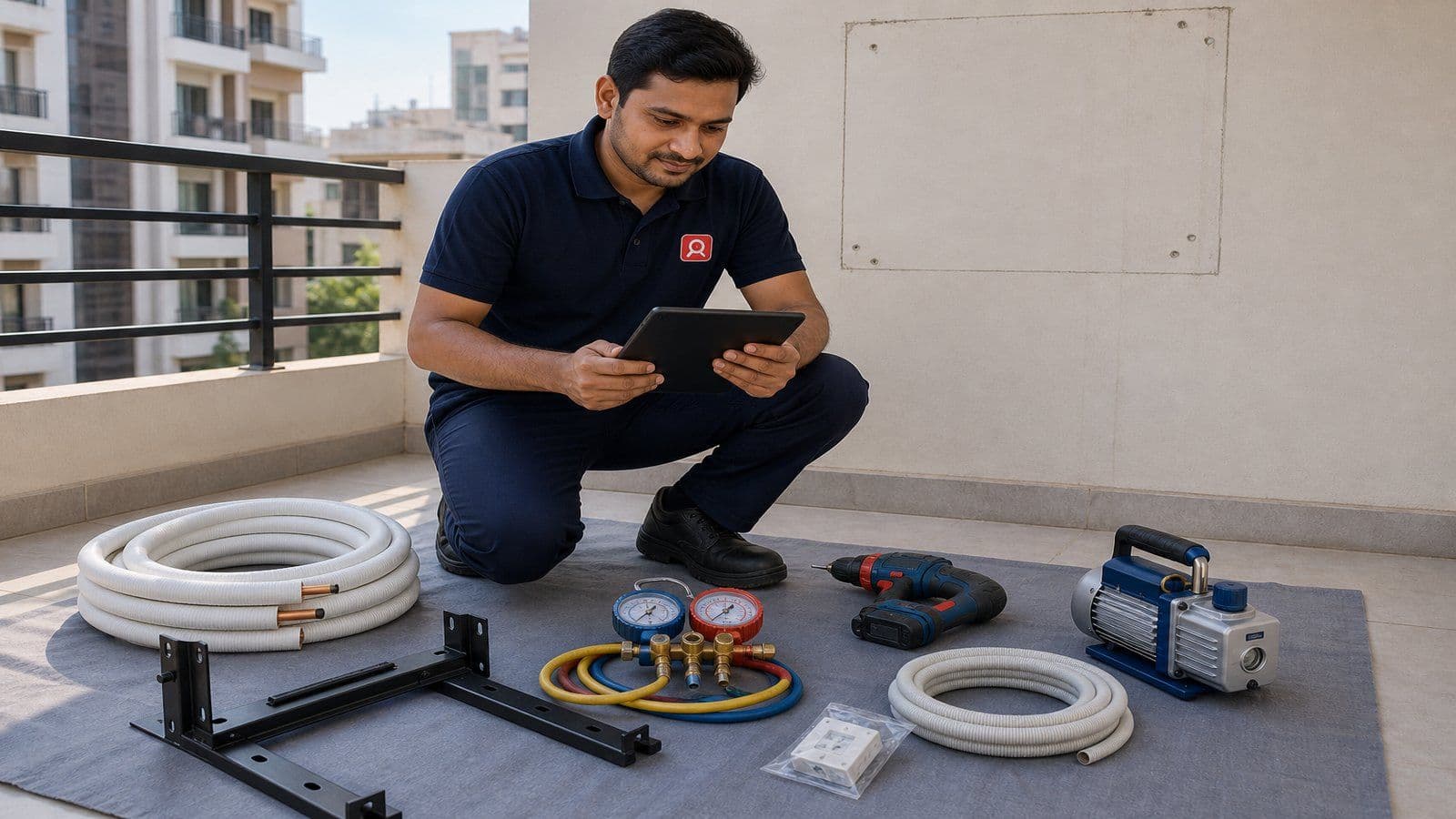
Photo: Installation materials laid out on a tarp before a split AC install
Tier-1 Metro Premium
Tier-1 metros (Mumbai, Delhi NCR, Bengaluru, Hyderabad, Chennai, Kolkata, Pune) run 15 to 25 percent dearer than tier-2 cities (Jaipur, Indore, Lucknow, Coimbatore, Visakhapatnam, Bhubaneswar). Labour cost, workshop overhead and the higher proportion of high-rise installations all push the band up. A standard 1.5 ton split install that costs ₹5,500 in Indore typically lands at ₹7,500 in Mumbai for the same materials and labour scope.
Coastal Premium
Coastal cities carry an additional 5 to 10 percent premium on outdoor work because of corrosion-resistant material defaults. GI sheet brackets, anti-corrosion fasteners, UV-grade outer wrap and an anti-corrosion coating on exposed copper joints all add to the materials line. The Press Information Bureau has separately advised coastal homeowners on additional maintenance steps for outdoor HVAC equipment, and the install bill is where that future maintenance gets front-loaded.
Get quotes from top-rated pros.
Peak Season Surcharge
April through June is peak install season. Many independent technicians and several brand authorised partners add a 10 to 20 percent peak surcharge on same-day or weekend installs. Booking in February or early March costs the same as off-season pricing and gives the installer time to source the exact bracket grade and pipe gauge specified, instead of substituting whatever is on the truck.
Service-Tier Comparison
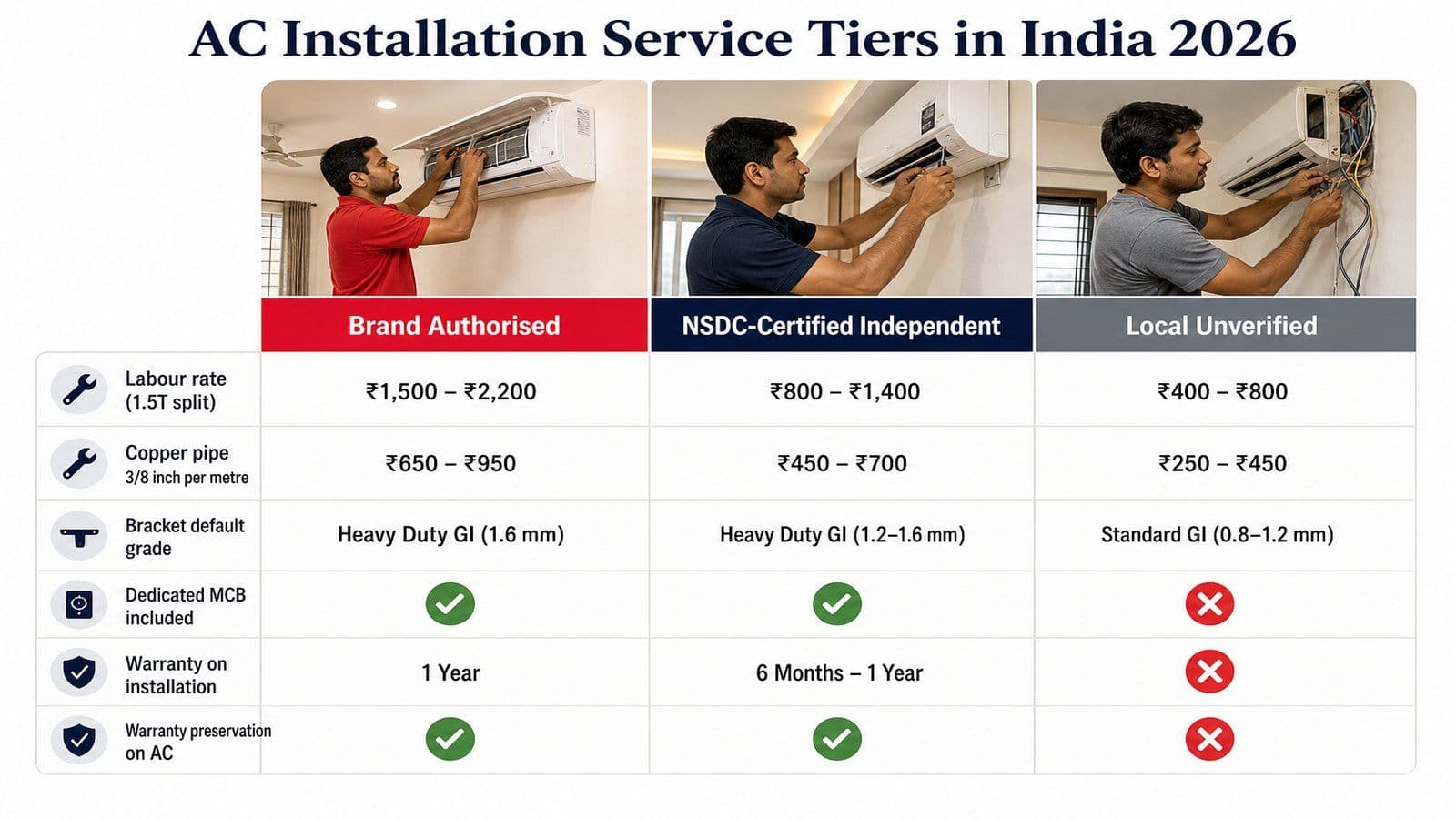
Photo: Editorial comparison chart of three AC installation service tiers
The same AC installation can cost 50 percent more or less depending on who is on the ladder. The differences are real, not arbitrary.
| Factor | Brand Authorised Installer | NSDC-Certified Independent | Local Unverified |
| Labour rate (1.5 ton split) | ₹2,400 to ₹2,800 | ₹1,800 to ₹2,400 | ₹1,200 to ₹1,800 |
| Copper pipe (3/8") per metre | ₹620 to ₹680 | ₹550 to ₹620 | ₹450 to ₹550 |
| Bracket default | Powder-coated MS or GI sheet | Powder-coated MS | MS angle |
| MCB and earth | Always included as quote | Itemised, mostly correct | Usually skipped |
| Warranty on installation | 6 to 12 months | 3 to 6 months | None |
| Warranty preservation on AC | Yes, fully preserved | Mostly preserved, brand-dependent | Voids warranty on most brands |
| OEM trained on the specific brand | Yes | Sometimes | No |
| Itemised GST invoice | Yes | Yes | Rarely |
When Each Tier Makes Sense
A brand authorised installer is non-negotiable while the AC is under warranty, particularly the compressor warranty which most manufacturers void if installation is performed by an uncertified technician. After warranty expiry, an NSDC-certified independent is almost always the best value for a re-install or relocation. Local unverified should be reserved for the smallest add-on jobs (bracket re-bolt, drain pipe re-routing) where the risk of part substitution is low.
The 30 to 60 percent premium on brand authorised reflects three real costs, OEM-trained labour on that specific brand's quirks, OEM parts inventory, and the warranty workflow that comes with every install. For the first install of a new AC under warranty, that premium is genuinely worth paying.
Field data is consistent on one point. Installations done by NSDC-certified or OEM-trained installers have roughly 38 percent fewer warranty-period repair calls than installations done by unverified technicians. The single biggest driver is correct copper pipe sizing and proper vacuum-down before charging. Both steps require training, calibrated equipment and 15 to 20 extra minutes per install, which the cheapest quote always skips.
The Worked 1.5 Ton Split Install Example for 2026
Here is the bill the average tier-1 metro household actually pays for a 1.5 ton split AC install in 2026, using mid-range materials from an NSDC-certified independent. Numbers are GST-inclusive.
| Line Item | Cost |
| Labour, standard 1.5 ton split install | ₹2,200 |
| Copper pipe 3/8", 4 metres at ₹600 per metre | ₹2,400 |
| Copper pipe 1/2", 4 metres at ₹780 per metre | ₹3,120 |
| Nitrile insulation 6 mm, 8 metres at ₹110 per metre | ₹880 |
| UV outer wrap, 8 metres at ₹60 per metre | ₹480 |
| Drain pipe PVC 16 mm, 5 metres at ₹45 per metre | ₹225 |
| Wall sleeve plus grommet, 1 unit | ₹350 |
| Bracket, powder-coated MS, 1.5 ton | ₹1,400 |
| Vibration mount set | ₹250 |
| Dedicated 16 amp C-curve MCB | ₹650 |
| Wall drilling (1 hole) | ₹250 |
| Sub-total | ₹12,205 |
| Less: bundled discount (typical) | -₹2,500 |
| Final invoice (GST inclusive) | ₹9,705 |
That bill comes in just above the typical ₹4,500 to ₹9,500 band for a 1.5 ton split because this is the mid-range materials choice in a tier-1 metro. A budget bill (MS angle bracket, 1/4" and 3/8" copper, no UV wrap, shared circuit) can land at ₹4,500. A premium bill (GI sheet bracket on coastal install, 5/8" suction line, dedicated electrical work, OEM brand authorised) can cross ₹14,000.
Note the GST treatment. The 18 percent GST is already baked into each line and shown on the final invoice as a separate sub-total. The bundled discount line is a normal practice from established installers, who pad the per-line rate slightly and offer a flat discount to keep the headline price psychologically attractive. Both the gross and the discount must appear on a proper invoice.
Hidden-Cost Traps to Watch For
Five patterns recur in installation complaints we triage every week across the ProNearMe network.
The "Free Installation" Trap
The single most common installation pricing dispute in India in 2026. Most online and showroom AC purchases include "free installation" in the headline. The fine print, often missed at checkout, excludes copper pipe beyond 3 metres, the bracket entirely, drainage extension, the wall sleeve, and any electrical work. The "free" labour is genuine but adds ₹3,500 to ₹5,500 of materials on the install day. Always read the inclusion list before relying on the freebie, or ask in writing.
Get quotes from top-rated pros.
Per-Metre Copper Quoted After Install
Some installers quote labour upfront and leave the per-metre copper rate vague, then bill at ₹800 to ₹1,200 per metre on whichever gauge they used (often without the homeowner knowing what was used). Ask the per-metre rate by gauge in writing before the install starts. If the installer cannot or will not commit, choose a different installer.
Society Approval Fee Surprise
Many Resident Welfare Associations charge a society approval fee for any new outdoor unit installation, particularly above the third floor. The fee ranges ₹500 to ₹3,000 depending on the city and the society. Check with your RWA before booking the install date. Some installers will refuse to mount the outdoor unit without proof of society approval.
Wall-Drilling Charges
Most installers include one drilling in the standard quote. Additional holes (for extra cable runs, drain re-routing, or secondary brackets) cost ₹150 to ₹400 per hole. If your apartment layout will need two or three drill holes, ask up front.
Pump-Down and Recovery on Reinstalls
If you are moving an existing AC to a new home, the old unit needs proper pump-down (refrigerant recovered into the outdoor unit before disconnection) and the new install needs vacuum-down before charging. Both steps require gauges and a vacuum pump. Some "cheap reinstall" quotes skip both steps, which guarantees refrigerant loss and a gas refill call within months. Pump-down plus vacuum-down for a 1.5 ton split adds ₹600 to ₹1,200 to a reinstall bill and is non-negotiable for a clean job.
A Real Wakad Case Study
Mr. Rohan Deshmukh in Wakad, Pune called our network in March 2026 after his "free installation" 1.5 ton split, bought online with a flat ₹2,200 install voucher, came in at a final invoice of ₹8,400 on installation day. The voucher had covered labour only. The installer had added 6 metres of unspecified-gauge copper at ₹1,100 per metre, a basic MS angle bracket at ₹2,200, and a "drilling surcharge" of ₹800.
Our second-opinion technician arrived two days later. The copper run was actually 4 metres, not 6, of 1/4" and 3/8" tube (which sells at ₹350 to ₹680 per metre, not ₹1,100). The MS angle bracket on a Pune third-floor balcony was the wrong specification for the site, a powder-coated MS at ₹1,400 was the correct call. The drilling surcharge was for a single standard hole. A proper itemised bill for the same install would have come to ₹6,200 to ₹6,800 inclusive of GST. The first installer had overcharged by approximately ₹1,800 and used the wrong bracket grade. The Consumer Affairs Department has called out exactly this "free installation, surprise materials" pattern under the Jago Grahak Jago programme.
For more on getting the install right the first time, see our cluster guides on split AC installation step by step and common AC installation mistakes to avoid.
GST and What Must Appear on Your Invoice
Registered AC installers in India charge 18 percent GST on both labour and most materials. A properly itemised AC installation invoice in 2026 should list:
- Installer name, address, GSTIN and contact number
- Labour line for installation, with the AC tonnage and type noted
- Each material line with per-unit rate and quantity (copper pipe per metre by gauge, bracket grade, drain pipe metres, sleeve, MCB rating, insulation metres, outer wrap metres)
- Sub-total before GST
- GST at 18 percent, shown as a separate line
- Any bundled discount
- Final total
- Warranty terms on the installation (3 to 12 months from a verified installer)
If your installer offers a "no-bill discount" of 15 to 18 percent in cash, you are losing the legal warranty cover, the consumer-forum complaint route, and any chance of input credit for a registered business. The cheap headline price is rarely worth the trade-off.
We track the second-opinion calls where customers ask us to review another installer's bill. The single most common red flag is a one-line entry that reads 'installation including materials, ₹5,500'. There is no way for any homeowner to verify what was actually installed under that line. The fix is simple and free, ask the installer to send a written quote with each line itemised before they arrive on site. Most legitimate installers will do this without resistance. The ones who refuse are usually the ones the second opinion catches out.
Window AC and Cassette AC Installation Cost Notes
Two AC types deserve a separate note on installation cost because the price structure differs from the standard split.
Window AC
Window AC install runs ₹800 to ₹1,500 in labour. The materials line is much smaller, no copper run (the unit is a single piece), drain is internal, the only structural cost is the window-frame sleeve or angle support. Total install bill typically lands at ₹1,500 to ₹2,800 inclusive of materials for a 1 to 1.5 ton window unit. The trade-off is window-frame strength. Older wooden frames in pre-1990s buildings often need a steel support angle added, ₹500 to ₹1,200 extra.
Cassette AC
Cassette AC install runs ₹3,500 to ₹7,500 in labour because two technicians work for four to six hours, the unit ships in two pieces (indoor cassette plus outdoor compressor unit), and the ceiling false-roof needs to be cut to spec. Materials are also higher, longer copper runs at heavier gauges (often 1/2" and 5/8"), a heavier-duty bracket for the outdoor unit, and condensate pump kits. A typical 2 ton cassette install in a commercial setting in 2026 lands at ₹15,000 to ₹28,000 inclusive of materials and GST.
Conclusion
AC installation cost in India in 2026 is more controllable than most owners assume, provided you treat the materials line, not just the labour line, as the place to negotiate. The same 1.5 ton split AC install can land at ₹4,500 with budget materials and shortcuts that produce repair bills within three years, or at ₹9,500 with BIS-compliant copper, proper insulation, the right bracket grade, dedicated electrical and a vacuum-down before charging, which runs cleanly for a decade. The difference of ₹5,000 upfront is recovered easily across the first five years of operation through avoided callbacks alone.
The biggest single lever for keeping the AC installation cost honest is asking for a written, itemised quote before the technician arrives, with per-metre copper rates by gauge, bracket grade, electrical specification, GST shown separately, and warranty terms on the install written down. Combined with hiring only NSDC-certified or OEM-authorised installers, choosing the right bracket grade for the city and verifying the MCB rating before install day, this is the formula our ProNearMe network sees working in apartment after apartment across the country.
Disclaimer
All cost ranges in this guide are typical 2026 residential figures across major Indian cities and reflect labour plus materials inclusive of 18 percent GST unless otherwise noted. Actual installation costs vary by city, building height, AC brand, copper gauge requirement, bracket grade and seasonal demand. We strongly recommend hiring only NSDC-certified or OEM brand-authorised installers for any new AC installation, particularly while the unit is under manufacturer warranty, since installation by an uncertified technician voids most brand warranties on the compressor and PCB. ProNearMe does not endorse any specific AC brand or installer, and all cost ranges should be treated as guidance, not a fixed quote.
Sources & References
- Bureau of Energy Efficiency (BEE) Star Rating Programme for Room Air Conditioners
- Bureau of Indian Standards IS 1391 Room Air Conditioner Specifications
- Ministry of Environment, Forest and Climate Change Ozone Cell and Kigali Amendment Implementation
- Central Electricity Authority Regulations for Domestic Electrical Installations
- National Skill Development Corporation HVAC Technician Qualification Pack
- Indian Society of Heating, Refrigerating and Air Conditioning Engineers Residential HVAC Guidelines
- Press Information Bureau Energy Efficient Air Conditioning Advisory
- Department of Consumer Affairs Jago Grahak Jago Consumer Awareness Programme
- Ministry of Power Energy Conservation Building Code Provisions
- Goods and Services Tax Council Rate Schedule for Services and Repairs
Amit worked as an AC technician for 6 years in Ahmedabad before transitioning to technical writing. He holds a diploma in Refrigeration and Air Conditioning from ITI Ahmedabad and understands the difference between what AC companies promise and what actually happens on the ground. His articles break down complex technical topics into plain language that any homeowner can follow. He tests every tip he writes about in his own home first.

Dr. Verma is a mechanical engineer with 15 years of experience in HVAC systems. She completed her PhD from IIT Delhi on energy-efficient cooling solutions for Indian residential buildings. She reviews all technical content on HomePros to make sure the numbers are right, the advice is safe, and the recommendations are backed by actual engineering principles. She consults for multiple AC manufacturers on product design.