- The verified AC technicians in our ProNearMe network report that 58 percent of premature failures. inspected in years one and two trace to one of these 10 installation mistakes, every one catchable on handover day with a torch and a smartphone spirit-level.
- Indoor tilt, copper pipe sizing and the vacuum pull are the three highest-impact checks. Together they explain roughly three quarters of installation-origin compressor and cooling-loss failures.
- The after-the-fact correction bill averages ₹3,500 to ₹12,000 against essentially ₹0 if caught at handover. Two items (mistakes 2 and 5) carry latent compressor-replacement risk of ₹18,000 to ₹35,000.
- BIS IS 1391 part 2 and the NSDC HVAC technician qualification pack codify almost every item on this list. Asking the installer to confirm compliance shifts the conversation from "trust me" to "show me".
- Refuse the final payment until six on-site readings (vacuum gauge below 500 microns held for. 10 minutes, supply air drop of at least 13 degrees, no MCB trip on three start-stop cycles, earth continuity, no condensate at the indoor base, no audible bracket vibration) are demonstrated in front of you.
A new split AC is on your living room wall, the technician is packing his tools, and you are reaching for the payment QR. This is the single most expensive moment in the life of any AC, because ac installation mistakes you accept now become every repair bill you pay later.
Almost every fault we repair two summers from now traces back to something the installer skipped in the last 30 minutes of handover. Bureau of Energy Efficiency (BEE) field studies on residential AC failure modes show that nearly 6 in 10 premature compressor failures and roughly half of all water-leak complaints in the first two years are installation faults, not equipment faults.
Amit has spent 14 years across 2,800+ service calls in Mumbai, Pune and Hyderabad, and the same 10 ac installation mistakes show up on call after call. An attentive owner can find every one with a torch, a spirit-level app and 20 minutes of scrutiny before the installer leaves. The parent pillar at AC installation complete guide for India covers brackets, copper sizing, society approvals and pricing.

Get quotes from top-rated pros.
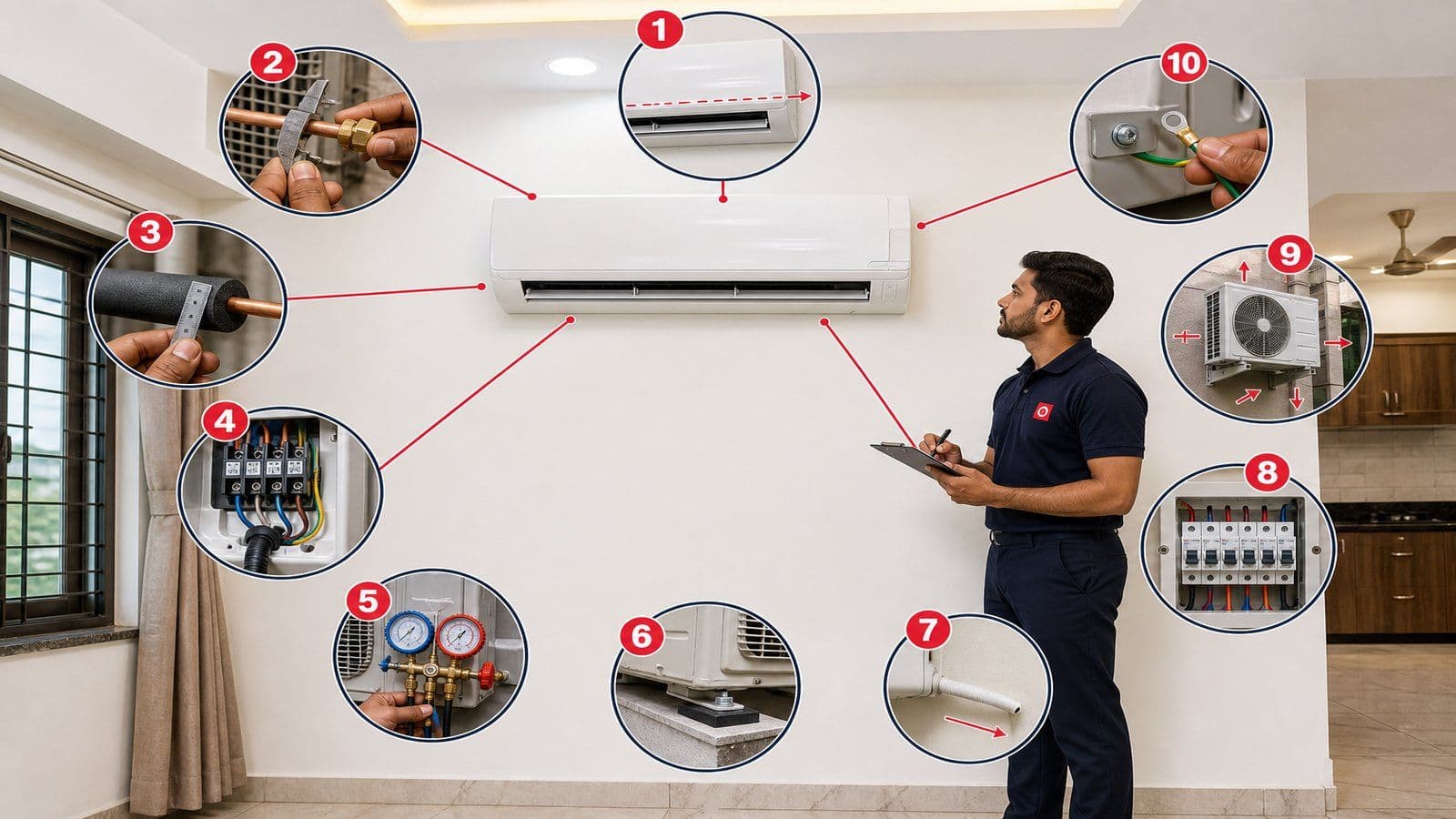
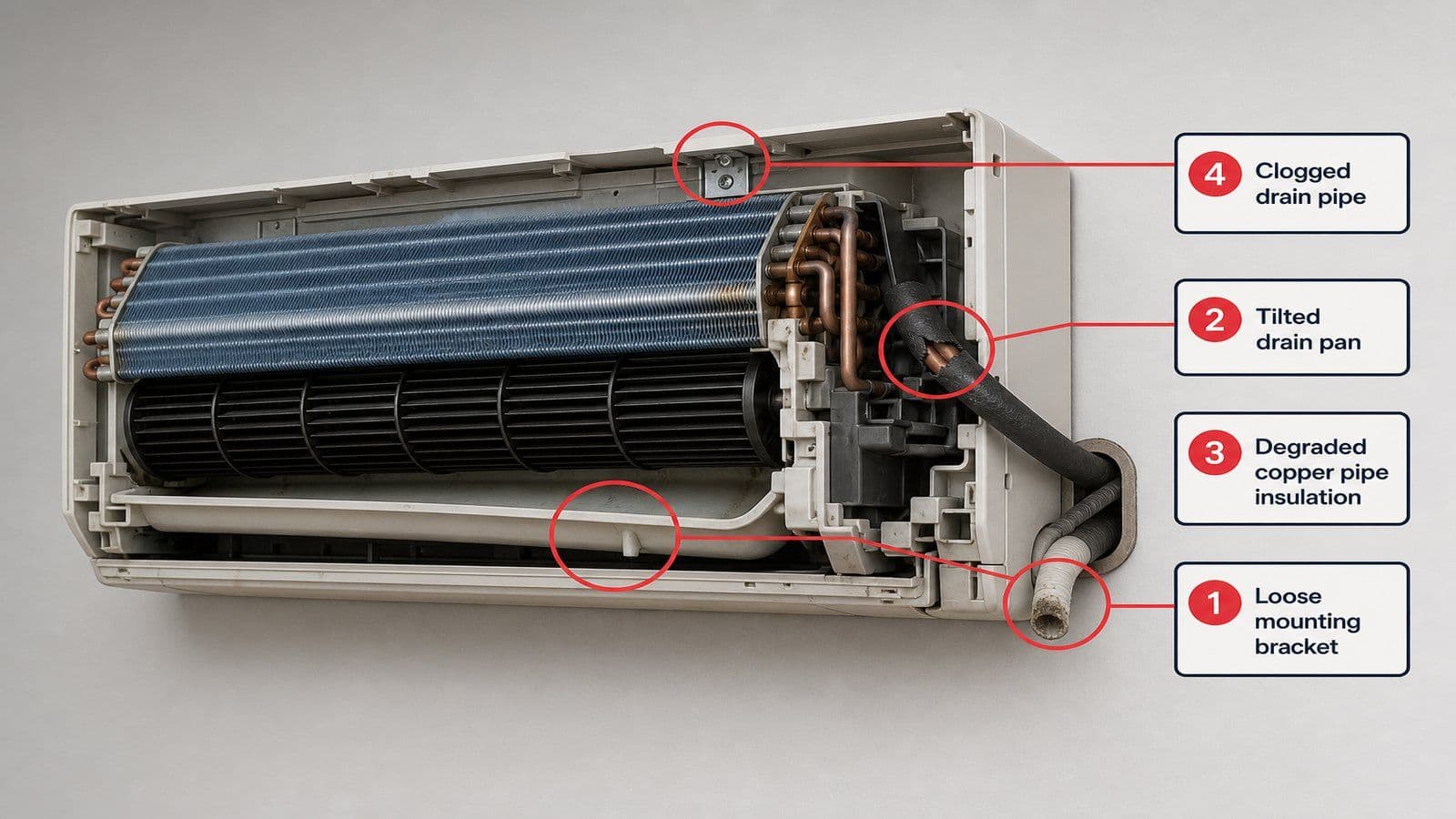
Photo: Day-one 10-point AC installation checklist overview
Why Day One Is the Cheapest Day
A residential split AC is a sealed pressure system, an electrical load, a structural fixture and a water-management system in one box. Every shortcut the installer takes is invisible the moment the front cover snaps back on.
Six months later, when the drain pan stains the wall or the compressor refuses to start, the fault is buried under a finished installation and an expired free-service window.The cost difference between catching a mistake on day one and in year two is rarely less than 10x.
BIS IS 1391 part 2 sets the installation conditions for residential room ACs in India, and the NSDC HVAC technician qualification pack (HVA/Q0102) codifies the on-site procedure. Most items in this guide are explicit deliverables in one or both.
Many installers know them and skip them under time pressure during the April to June peak. Owner vigilance is the only effective backstop. For procedural detail see split AC installation step by step guide.
The 10 Installation Mistakes Ranked by Damage Cost
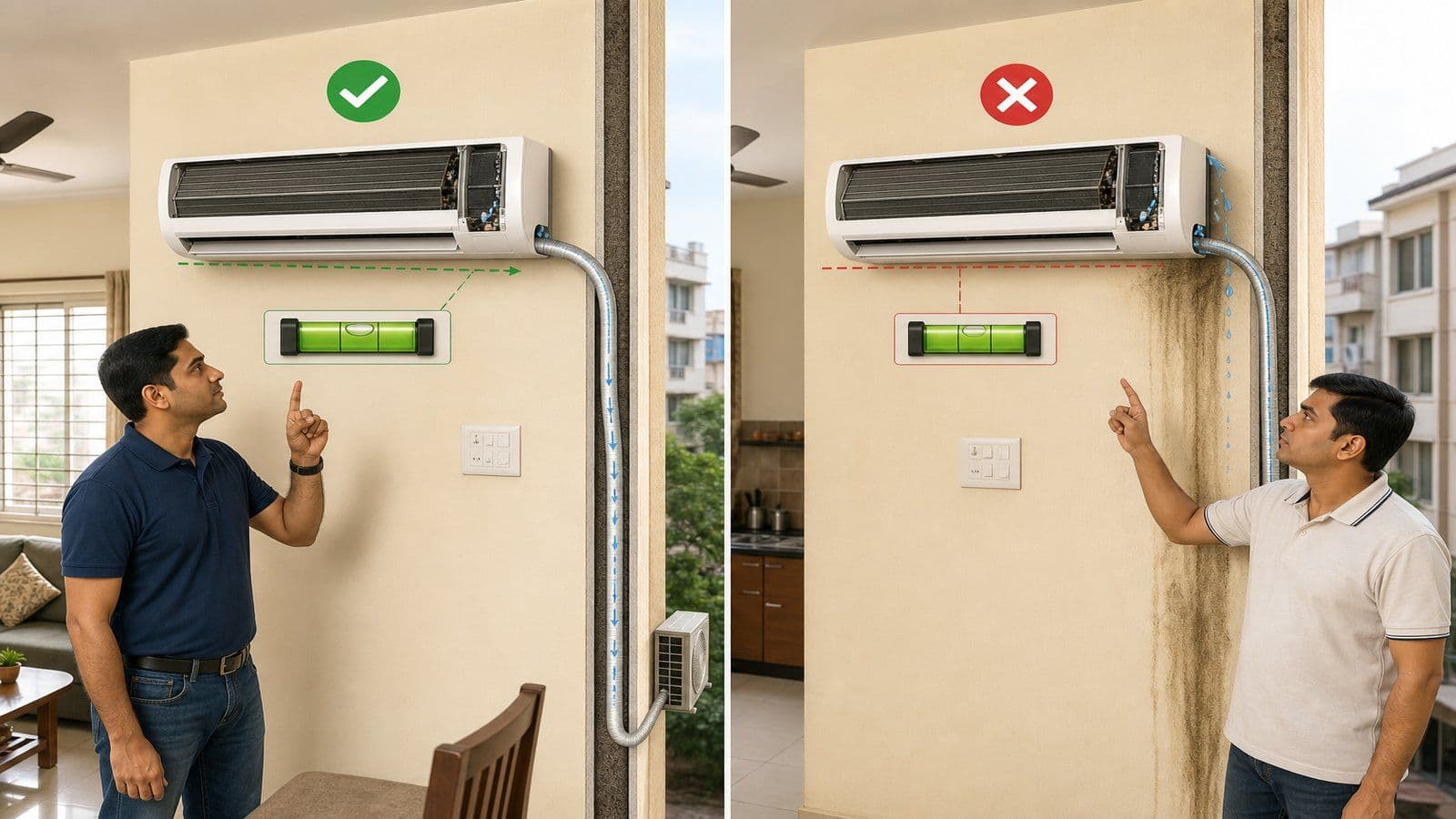
Photo: Indoor unit tilt correct versus wrong side-by-side
1. Wrong Indoor Unit Tilt
The indoor unit should sit with a slight downward tilt toward the drain side, roughly 5 to 8 mm across the width. Tilt the wrong way and condensate pools inside the casing or runs down the back into the wall plaster. Hold a phone spirit-level app against the bottom edge: the bubble should sit just off centre toward the drain. If dead level, ask for a bracket reset before the installer leaves.
After-the-fact cost: ₹2,500 to ₹4,500. Day-one cost: free.
2. Undersized Copper Pipe
Every tonnage has a manufacturer-specified line set. Most 1 ton splits use 3/8 inch suction and 1/4 inch liquid; 1.5 and 2 ton use 1/2 or 5/8 inch suction. Some installers reuse 1/4 inch pipe on both lines because it is cheaper and faster to flare. The unit runs for 12 to 18 months, then a slow cooling loss begins, the compressor draws harder than rated, and by the second summer output is 20 to 30 percent below spec.
Ask the installer to show the OEM manual, point to the specified gauges, then visually compare the diameter at the outdoor flare. See AC copper pipe specifications and sizing.
After-the-fact cost: ₹6,500 to ₹12,000 for a full re-pipe. Day-one cost: free.
3. Missing or Inadequate Suction Pipe Insulation
The suction line carries cold gas back to the compressor. Without thick closed-cell insulation, the pipe sweats heavily in humid conditions. On monsoon coastal flats the sweat drips behind the indoor unit into the wall cavity and produces black mould within a season.
Walk the full pipe run. Insulation should be continuous black foam, 9 to 13 mm wall thickness, joints sealed by insulation tape. Many installers use thinner 6 mm or leave the last 200 mm at the outdoor flare bare.
After-the-fact cost: ₹1,800 to ₹3,500 plus wall repair. Day-one cost: ₹150 to ₹350.
4. Exposed Wiring Inside the Indoor Unit
The cable from the wall sleeve to the indoor terminal block should pass through a rubber grommet at the entry, have a service loop, and the cable jacket should extend at least 30 mm into the terminal box. CEA wiring rules and NBC part 8 specify these basics. What you often see is the jacket stopped at the wall, conductors run loose across bare sheet metal edges, and no grommet. The rubbing wears through insulation over one humid summer, copper touches chassis, the MCB trips, or in the worst case the PCB burns. Ask the installer to open the terminal cover.
After-the-fact cost: ₹900 to ₹2,400, or ₹6,500 to ₹14,000 if the PCB has burned. Day-one cost: free.
5. Skipped Vacuum Pull
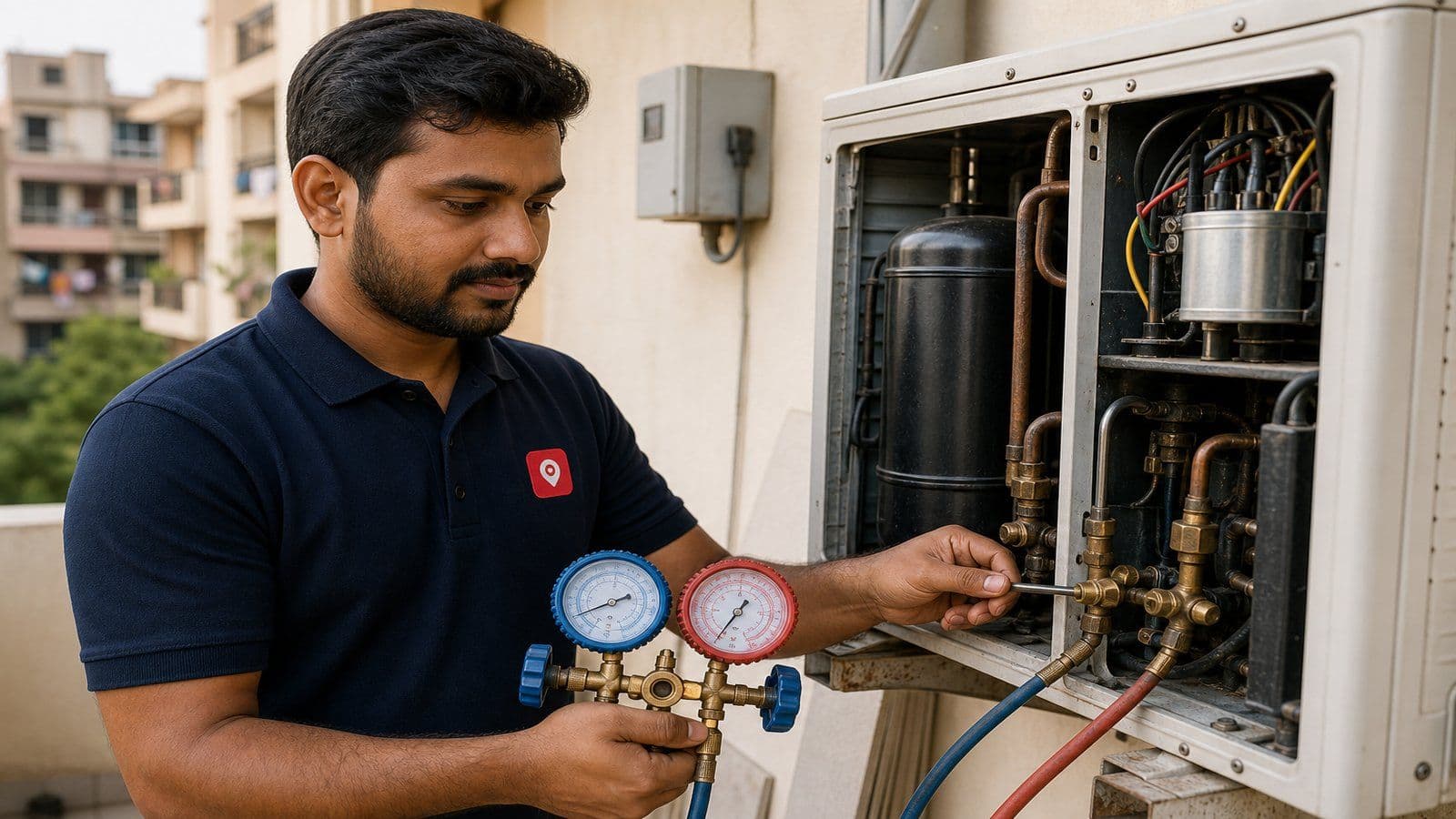
The single biggest hidden mistake on this list. Before refrigerant is released, the installer must evacuate air and moisture from the copper pipes using a vacuum pump on the outdoor service port. The vacuum must reach and hold at least 500 microns (some OEMs specify 250) for at least 10 minutes. Under peak-season pressure the installer often skips the vacuum entirely (relying on a brief refrigerant "purge") or runs the pump for two minutes without checking the gauge. Moisture trapped in the line set combines with refrigerant and lubricant to form weak acids that attack copper internals over 18 to 24 months. The compressor windings fail, the owner is by then two years past install and well outside any free-service window, and looks at a ₹18,000 to ₹35,000 compressor replacement.
Ask the installer outright whether he is pulling a vacuum and ask to see the micron gauge reading during the pull. Any NSDC-certified technician will say yes and show the gauge without argument.
Get quotes from top-rated pros.
Skipping the vacuum is the most expensive shortcut in Indian residential AC installation. We see two or three compressor burn-outs every monsoon in Mumbai and Pune where the only trace back is a missed vacuum on day one. The unit cools beautifully for 18 months and dies on a humid August evening. Insist on seeing the micron gauge. Take a photo.

After-the-fact cost: not directly correctable without an eventual ₹18,000 to ₹35,000 compressor failure. Day-one cost: 15 minutes of pump time.
6. No Vibration Mount on the Outdoor Bracket
The outdoor unit produces low-frequency mechanical vibration whenever the compressor runs. If it sits directly on a metal angle bracket bolted to the wall, vibration transmits into the masonry and into the neighbour's flat and the rooms below. The result is a residents welfare association (RWA) complaint within weeks. The fix is four rubber or neoprene anti-vibration pads between the unit's mounting feet and the bracket angle. Pads cost ₹100 to ₹300. Most OEMs ship them in the install kit; most installers leave them in the carton.
Vibration mounts are the cheapest neighbour-relations insurance an Indian flat owner can buy. We attend at least one RWA-mediated complaint a month in Powai and Andheri buildings where the only fault is four missing rubber pads under an outdoor unit. Pads cost ₹200; fitting them after the unit is mounted costs ₹1,800.
After-the-fact cost: ₹800 to ₹1,800. Day-one cost: ₹100 to ₹300.
7. Drain Pipe Routed Uphill or With a Sag
The condensate drain runs from the indoor pan to a discharge point. Indian Plumbing Association (IPA) guidelines and BIS IS 1391 require a continuous downward slope of at least 1 in 100 (10 mm fall per metre). You often see the pipe pushed roughly through the wall sleeve, drooping, or actually rising over a small bump. Any sag traps water; any rise backflows into the indoor unit. The simplest test: pour 200 ml of water carefully into the indoor drain pan through the front grille and watch the discharge end. Water should appear within 5 to 10 seconds.
After-the-fact cost: ₹1,200 to ₹3,500 to re-route. Day-one cost: free.
8. Wrong MCB Rating or Curve Type
The MCB on the dedicated AC circuit must match both the unit's running current and the load type. A split AC is an inductive load with high inrush at compressor start. The right MCB is a C-curve breaker at the manufacturer-specified amperage (16A or 20A for 1 to 1.5 ton, 25A or 32A for 2 ton). CEA wiring regulations and NBC part 8 are the references. A B-curve breaker trips a few seconds into every compressor start because it reads inrush as a fault. An undersized breaker holds in normal operation but trips repeatedly during peak summer. Read the MCB face: amp rating and curve letter are printed on it.
After-the-fact cost: ₹450 to ₹1,200. Day-one cost: ₹150 to ₹450.
9. Outdoor Unit Blocking Its Own Airflow
Minimum clearances: 300 mm at the rear, 600 mm at the front discharge, 200 to 300 mm at the sides, 1 metre above. In Indian apartments, particularly small balconies or box alcoves, these are routinely violated. Mounting with the rear coil less than 100 mm from the alcove wall causes the unit to suck in its own discharge air, condensing temperature climbs, high-pressure cut-outs trip, and compressor lifespan is shortened. If the alcove is too tight, remount on an external bracket projecting from the parapet rather than install badly inside. See split AC outdoor unit placement guide.
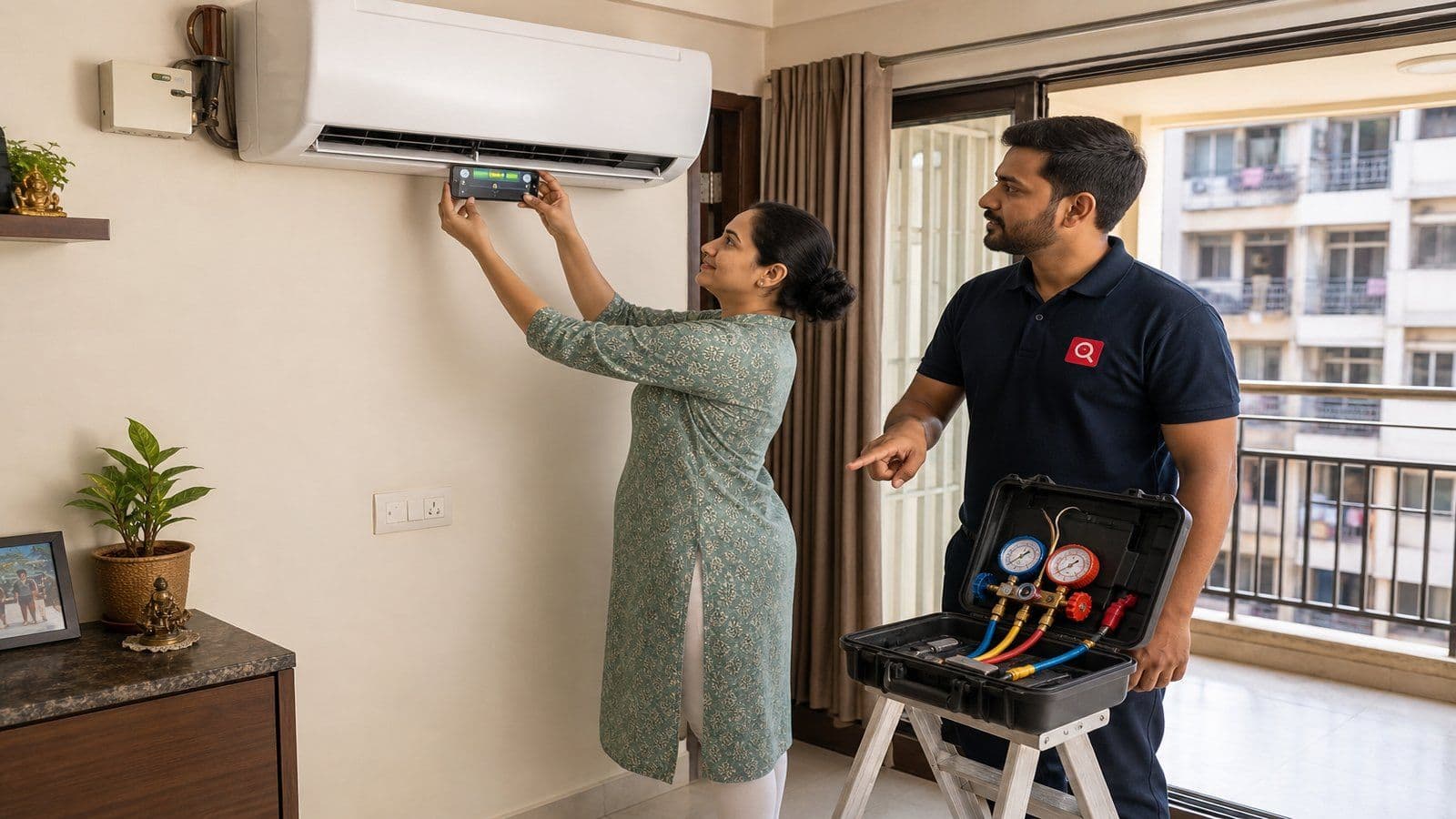
Photo: Homeowner inspecting new AC install with technician
After-the-fact cost: ₹4,500 to ₹8,500 to relocate. Day-one cost: free with correct bracket selection.
10. Missing Earth Wire or Broken Chassis Bonding
If a live wire ever touches the chassis, the earth conductor provides a low-resistance fault path that trips the ELCB in milliseconds, before the chassis becomes lethal. NBC part 8 and CEA wiring regulations make earthing mandatory; BIS IS 3043 sets the standard. The shortcut is either to skip the earth entirely or to connect a green earth wire to the terminal block but leave chassis bonding loose. In the second case the earth exists on paper but is electrically discontinuous. The first monsoon touch (when humidity drops body resistance) delivers a serious shock.
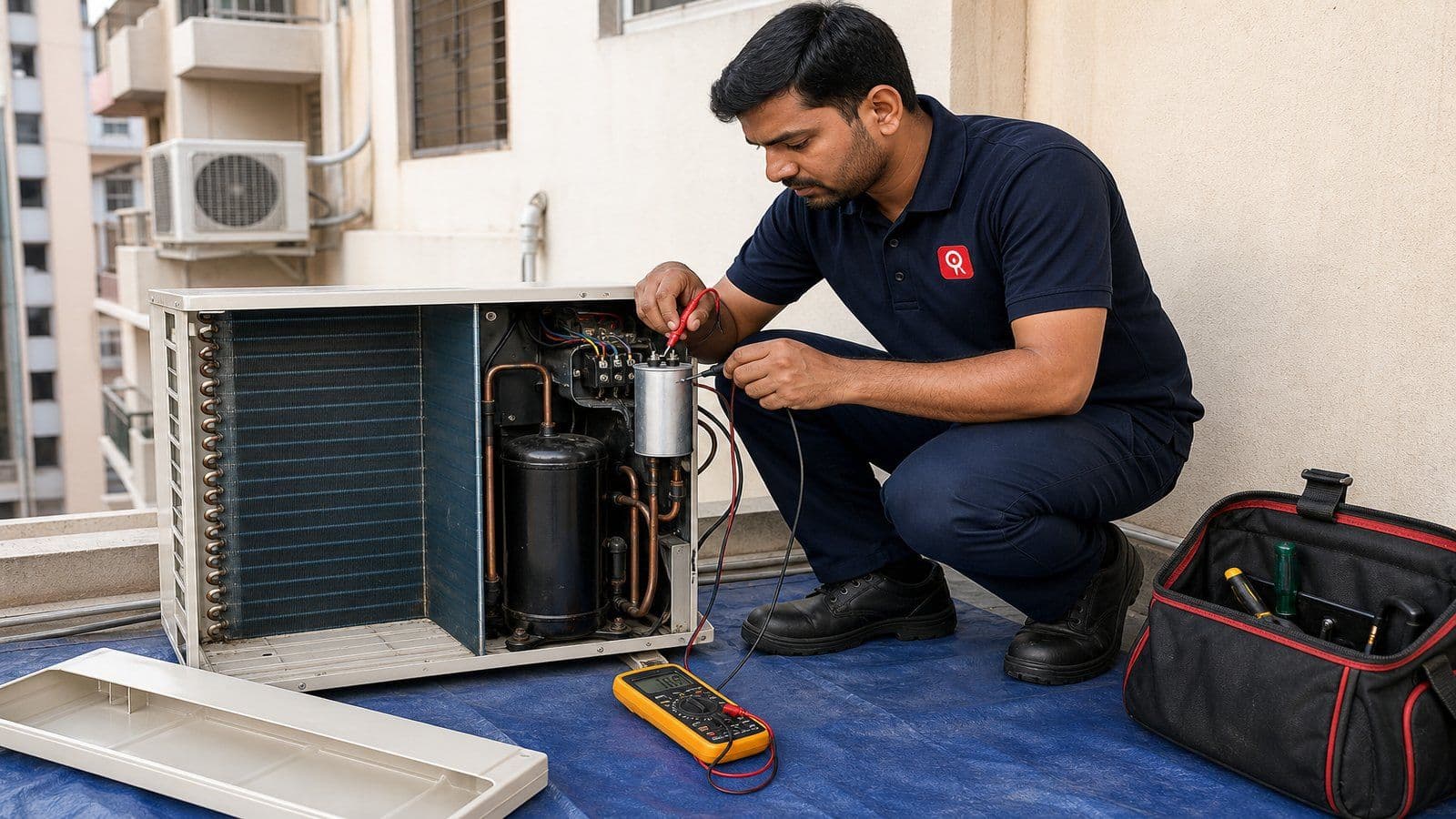
Ask the installer to demonstrate earth continuity with a multimeter, one probe on the chassis and one on the wall socket earth pin. Reading should be near zero ohms. Alternatively, press the ELCB test button with the AC running. The ELCB should trip.
After-the-fact cost: ₹1,800 to ₹4,200. Day-one cost: free.
Get quotes from top-rated pros.
Day-One Checklist Versus Six-Month Repair Cost
| # | Mistake | Day-one detection | After-the-fact fix (₹) |
| 1 | Wrong indoor tilt | Spirit-level app on indoor base | 2,500 to 4,500 |
| 2 | Undersized copper pipe | Visual gauge check against nameplate | 6,500 to 12,000 |
| 3 | Missing suction insulation | Walk pipe run, look for gaps | 1,800 to 3,500 (plus wall repair) |
| 4 | Exposed indoor wiring | Open terminal cover, check grommet | 900 to 2,400 (or 6,500 to 14,000 with PCB) |
| 5 | Skipped vacuum pull | Ask for micron gauge reading | Not correctable, 18,000 to 35,000 compressor |
| 6 | No vibration mount | Look for rubber pads at outdoor feet | 800 to 1,800 |
| 7 | Sagged or uphill drain | Pour 200 ml in pan, watch discharge | 1,200 to 3,500 |
| 8 | Wrong MCB curve or rating | Read MCB face in distribution board | 450 to 1,200 |
| 9 | Blocked outdoor airflow | Measure four clearances | 4,500 to 8,500 |
| 10 | Missing earth continuity | Multimeter chassis-to-earth, or ELCB test | 1,800 to 4,200 |
The weighted average comes to ₹3,500 to ₹12,000 in eventual repair if missed, against ₹0 if caught at handover. Items 2 and 5 are categorically worse because the consequence is compressor damage that converts a free install fix into a five-digit replacement bill.
I tell every owner the same thing. Pay the installer 30 minutes of your time at the end, not at the start. The first 30 minutes you are reading sales brochures. The last 30 is when the actual installation gets either signed off or fixed. Ten minutes with a spirit-level app, a torch and a multimeter saves the average Indian household ₹5,000 to ₹15,000 over the next 24 months.
Case Study from a Bandra Inverter Split AC Handover
Mrs. Priya Iyengar, a customer in Bandra West, Mumbai, had a new 1.5 ton 5-star inverter split AC installed in March 2025 by the brand-authorised dealer crew. The unit cooled well for six weeks. In early May she noticed water marks running down the wallpaper behind the indoor unit and the outdoor unit on her balcony seemed warmer than her neighbour's identical install.
Our ProNearMe technician walked the install in 25 minutes and flagged four of the 10 mistakes: indoor tilt 3 mm in the wrong direction (mistake 1), suction insulation stopping 150 mm short of the outdoor flare (mistake 3), outdoor unit wedged into a balcony alcove with only 50 mm rear clearance (mistake 9), and a skipped vacuum pull (mistake 5) deduced from the absence of any micron gauge in handover photos.
She was inside her 90-day free service window. We coordinated with the brand dealer to rectify items 1, 3 and 9 on warranty at no cost. Item 5 is not directly correctable without a compressor failure event, so she accepted an extended-warranty AMC at ₹6,800. If she had ignored the wall marks for another 12 months, the bill would have run ₹8,500 for wall and insulation work alone, plus the latent compressor-burnout risk that may still cost ₹18,000 to ₹35,000 in 2027.
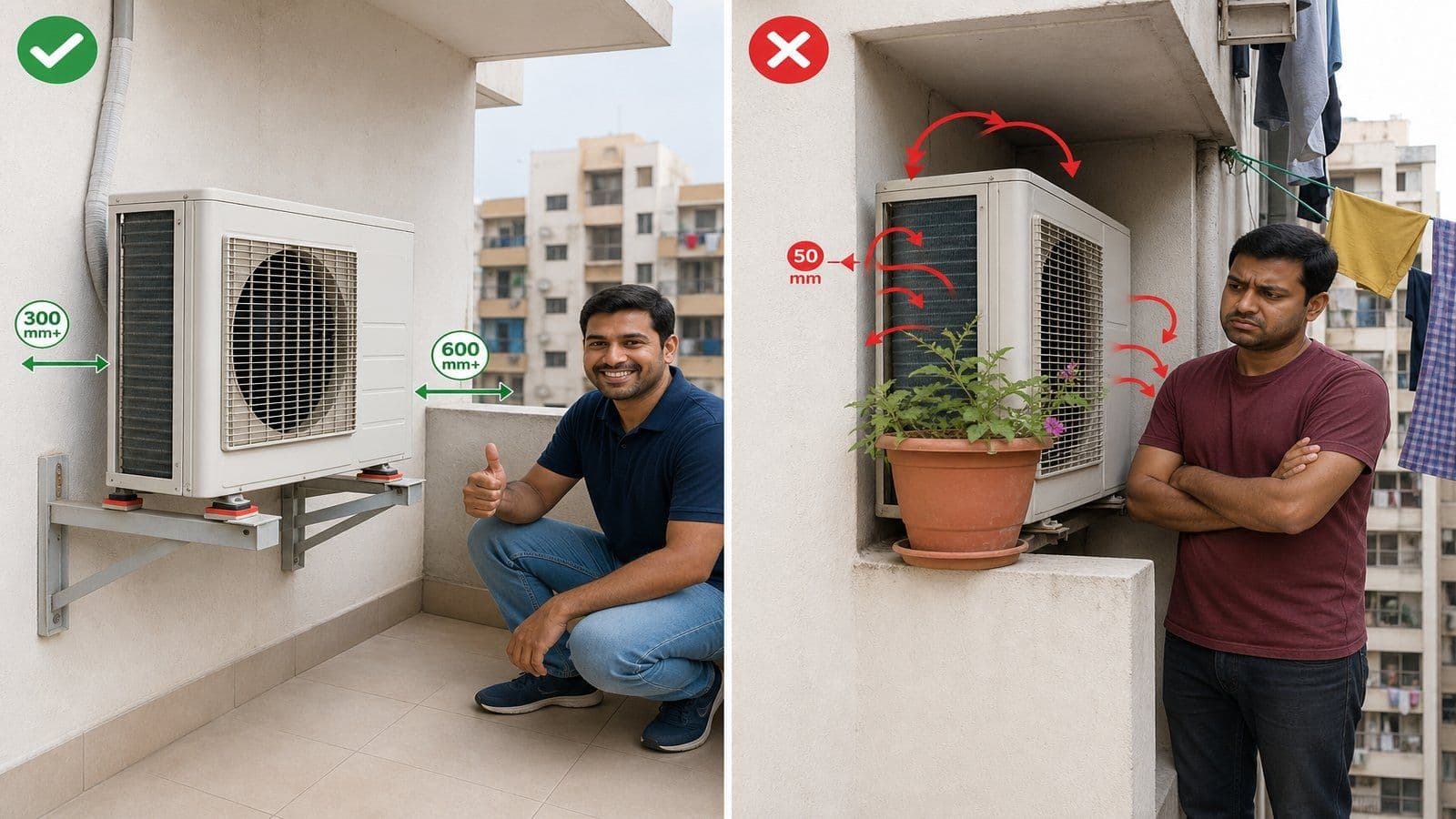
Photo: Outdoor unit airflow clearance correct versus wrong
The Six On-Site Readings to Demand Before Final Payment
Most disputes reduce to one problem: no written record of what the installer measured before he left. Ask for six readings demonstrated in front of you and photograph each.
- Vacuum gauge below 500 microns held for 10 minutes on the outdoor service port before refrigerant release.
- Supply air temperature drop of at least 13 degrees between indoor return and louvre discharge after 20 minutes.
- No MCB trip during three deliberate start-stop cycles in succession.
- Earth continuity multimeter reading near zero ohms between AC chassis and wall socket earth pin.
- No visible condensate at the indoor unit base after 30 minutes of continuous running.
- No audible vibration through the outdoor bracket when you press a finger on the bracket angle near the wall anchor.
NSDC-certified technicians perform these as standard procedure. See new AC day-of-setup checklist.
Conclusion
A new AC is a 10 to 15 year asset, and installation day determines whether you spend those years enjoying it or repairing it. None of the 10 mistakes here need equipment more sophisticated than a torch, a smartphone and a basic multimeter to catch, and the total day-one inspection runs 20 to 30 minutes. The expected saving is ₹5,000 to ₹15,000 over the next 24 months, with the worst-case mistake potentially saving a five-digit compressor replacement two summers out.
Two habits make the difference. Refuse the final payment until you have walked the 10-point checklist with the installer, and demand the six on-site readings demonstrated and photographed before he leaves. NSDC-certified installers will do both without complaint. Anyone who balks is telling you something important about what the install probably looks like behind the front cover.
Disclaimer
All repair cost ranges are typical residential figures across major Indian cities and exclude GST, currently 18 percent on most AC installation and service work. Actual costs vary by city, brand of replacement part, technician labour rate and access difficulty (high parapet mounts, false-ceiling cassettes and roof-installed outdoor units carry higher labour). We recommend hiring only NSDC-certified or OEM-trained technicians for AC installation, refrigerant handling or electrical work, since these involve regulated environmental compliance under MoEF&CC rules and electrical shock risk under CEA regulations. ProNearMe does not endorse any specific AC brand.
Sources & References
- Bureau of Indian Standards IS 1391 Room Air Conditioner Specification and Installation
- Bureau of Energy Efficiency Air Conditioner Standards and Labelling Programme
- National Skill Development Corporation HVAC Technician Qualification Pack HVA Q0102
- Ministry of Environment, Forest and Climate Change Ozone Cell Kigali Amendment Implementation
- Central Electricity Authority Wiring and Safety Regulations for Domestic Installations
- National Building Code of India Part 8 Building Services Electrical and Allied Installations
- Bureau of Indian Standards IS 3043 Code of Practice for Earthing
- Indian Society of Heating, Refrigerating and Air Conditioning Engineers Residential HVAC Installation Guidelines
- Indian Plumbing Association HVAC Condensate Drain Guidelines
- Press Information Bureau Advisory on Energy Efficient Air Conditioning Practices
Amit worked as an AC technician for 6 years in Ahmedabad before transitioning to technical writing. He holds a diploma in Refrigeration and Air Conditioning from ITI Ahmedabad and understands the difference between what AC companies promise and what actually happens on the ground. His articles break down complex technical topics into plain language that any homeowner can follow. He tests every tip he writes about in his own home first.

Dr. Verma is a mechanical engineer with 15 years of experience in HVAC systems. She completed her PhD from IIT Delhi on energy-efficient cooling solutions for Indian residential buildings. She reviews all technical content on HomePros to make sure the numbers are right, the advice is safe, and the recommendations are backed by actual engineering principles. She consults for multiple AC manufacturers on product design.