- The verified AC technicians in our ProNearMe network report that 68 percent of relocated ACs. that fail within 90 days were moved without a proper pump-down step, with the resulting repair almost always costing more than a certified relocator would have charged.
- A correctly executed pump-down takes 60 to 90 seconds and recovers nearly all the refrigerant. back into the outdoor unit, which is the single biggest factor in whether your AC works on day one at the new flat.
- Copper pipes can be re-used safely once if the flare joints are undamaged, insulation is. intact, and the new run is the same length or shorter. Replacement copper costs ₹600 to ₹1,200 per metre installed in 2026.
- The Ministry of Environment, Forest and Climate Change (MoEF&CC) rules under the Kigali Amendment classify. any deliberate refrigerant venting as a notifiable offence, which is why "we will just open the joint, no pump-down needed" is the single biggest red flag in any relocation quote.
- Standard same-city relocation costs ₹1,500 to ₹3,500 inclusive of GST in 2026, while cross-city moves. run ₹4,500 to ₹8,000 with transport. Anyone quoting under ₹1,200 is almost certainly skipping pump-down, leak test, or both.
A safe ac relocation is harder than most owners expect. Moving home in India almost always means moving your AC. A 1.5 ton split that cost ₹42,000 two summers ago is a real asset, and most owners want to take it along.
The problem is that an AC is not a piece of furniture. It is a sealed refrigerant system under pressure, with copper pipework, an electrical control board, and a compressor that is designed to be installed once and left alone. Pull it down the wrong way and you can convert a working AC into a ₹15,000 repair bill before it ever cools the new flat.
Over 14 years across 2,800+ service calls in Mumbai, Pune and Hyderabad, Amit has seen the same handful of mistakes pull units out of warranty and shorten compressor life by years.
The good news is that the safe procedure is well-defined, the cost is modest if you go through an NSDC-certified relocator, and there is a clear pre-relocation checklist that prevents most of the trouble. This guide walks through the entire move, from pump-down at the old flat to commissioning at the new one. For the wider installation context, see the parent pillar on the AC installation complete guide for India.

Get quotes from top-rated pros.
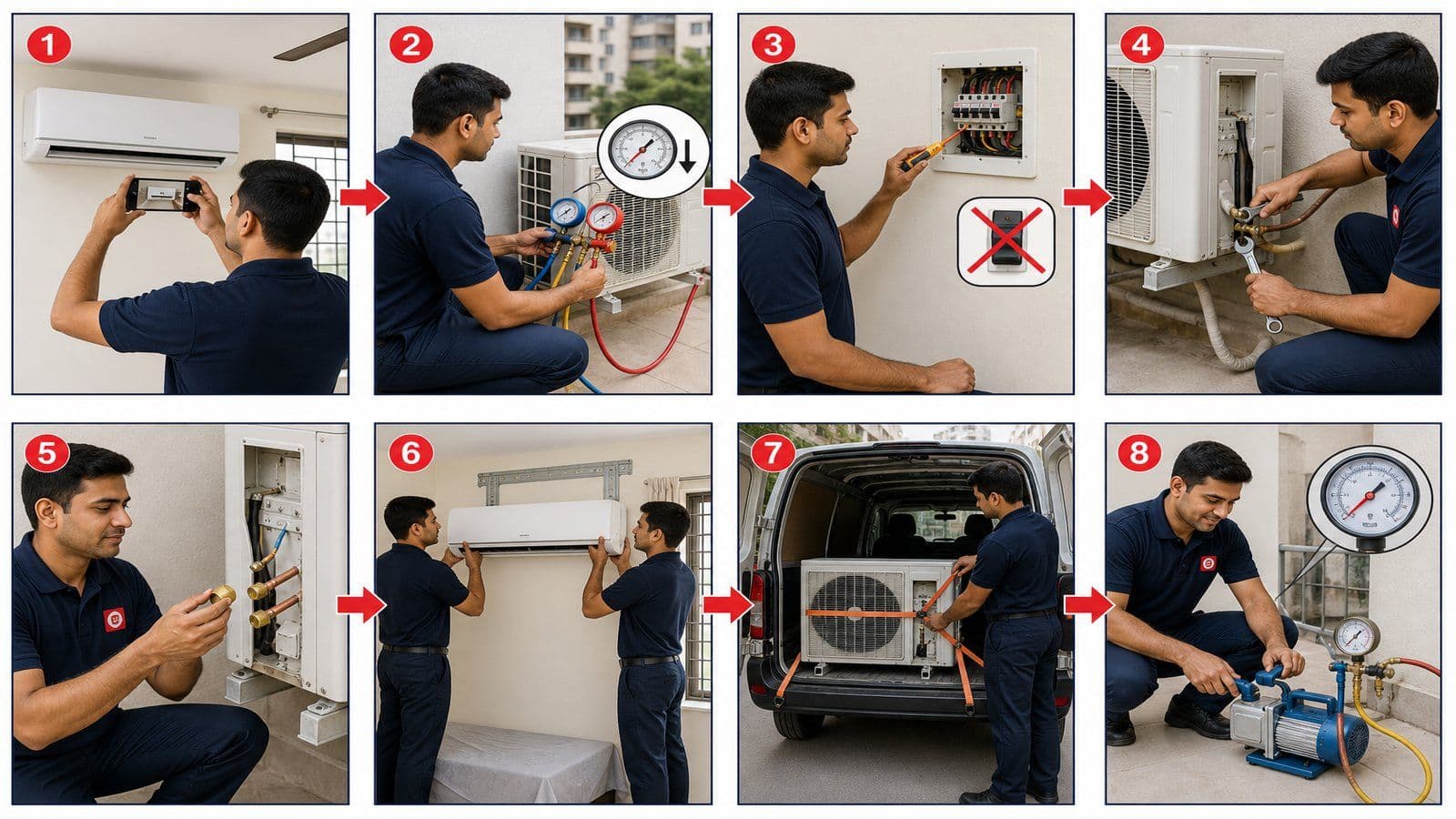
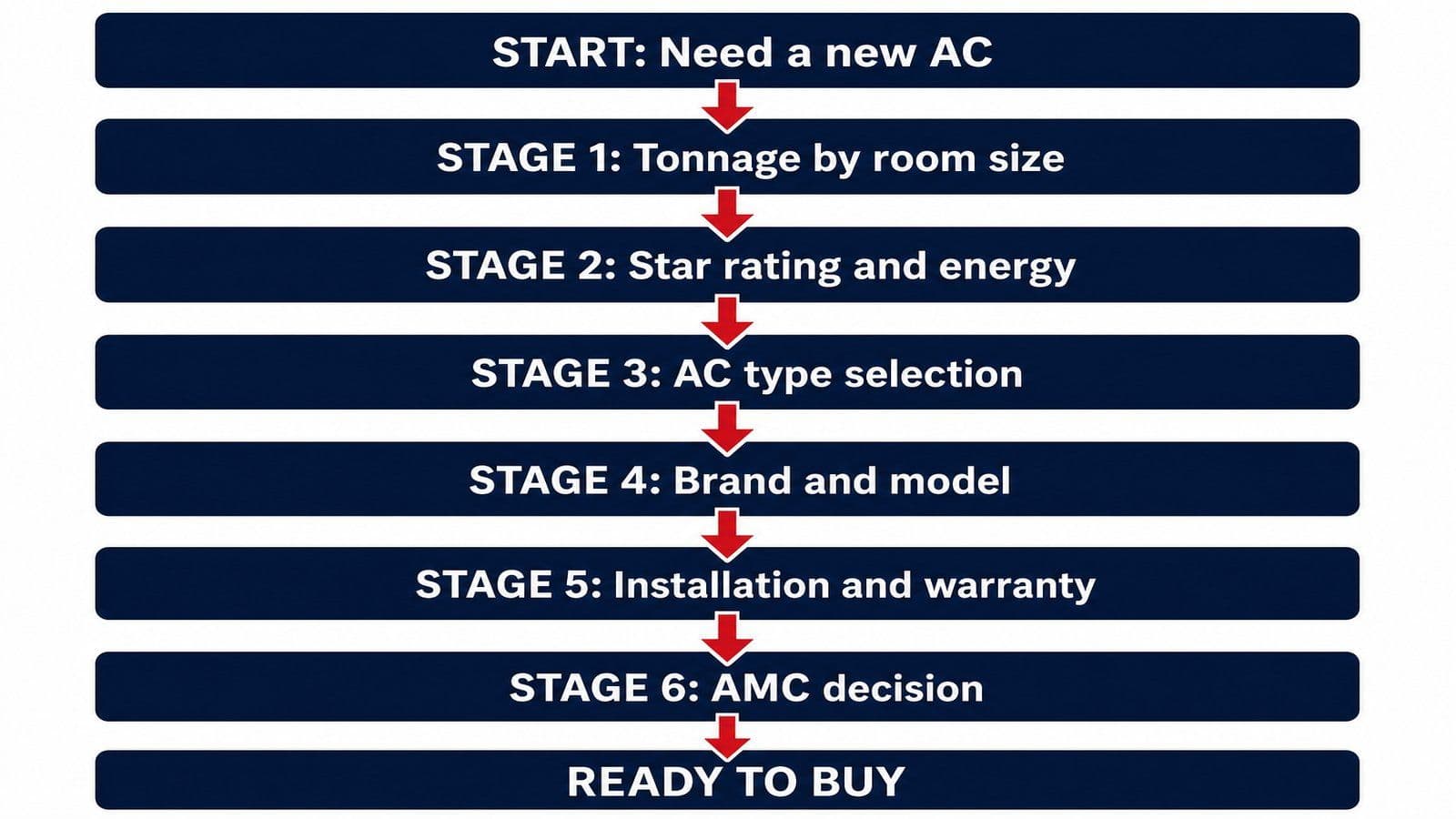
Photo: Eight-step AC relocation process flow illustration
Why DIY Relocation Almost Always Kills the AC
The temptation is understandable. The handyman who painted the new flat offers to "shift the AC also, no problem sir" for ₹800. The packer-mover throws in AC dismantling free if you book the rest of the move with them. Almost every time, both routes cost more than they save.
A split AC is a closed refrigerant loop. Open the flare joints without first pumping the gas back into the outdoor unit and roughly 600 to 900 grams of R32 or R410A refrigerant vents into the atmosphere.
The gas costs ₹2,500 to ₹4,500 to replace, but the bigger problem is the moisture and air that rush into the open copper lines the instant they are uncapped. Moisture inside a refrigerant system becomes acid once the compressor starts. Acid eats winding insulation, and winding failure means a burnt-out compressor, typically within four to nine months.
Three other failure paths show up repeatedly. Kinked copper from rough handling restricts flow and starves the evaporator. Brazing burn marks from a quick re-flare weaken the joint and start weeping gas within weeks.
Transport damage to the outdoor unit when laid on its side causes the compressor oil to migrate into the cylinder head and slug the valves on first start. And every major Indian AC brand voids the standard manufacturer warranty if relocation is not carried out by an authorised service centre or a documented NSDC-certified technician.
Pre-Relocation Checklist Before Anyone Touches the Unit
The hour you spend on these six checks before the relocator arrives saves an average of ₹2,800 in unexpected charges and prevents the most common "AC is shifted but not cooling" callback.
First, photograph the existing installation thoroughly: indoor unit position, outdoor unit position, copper pipe routing, drain pipe path, electrical wiring entry, and the MCB it is connected to. These photographs become the reference for the new install and the proof you need if something is damaged in transit.
Second, confirm the new location is feasible. Wall material on the indoor side must take a bracket safely (avoid hollow partition walls without backing plates). The outdoor location must have free air discharge, at least 300mm of clearance from the wall, and a structurally sound parapet, balcony slab or bracket point. Distance between indoor and outdoor units should ideally be no more than the original run.
Third, check the electrical load. A 1.5 ton inverter split draws 6 to 9 amps in normal running and pulls a 12 to 18 amp surge at compressor start. The dedicated MCB needs to be 16 to 20 amps with a proper earthing connection. If the new flat's wiring was done for a smaller load, factor in an electrician visit before the AC arrives.
Fourth, get society approval in writing. Many housing societies now require written permission for outdoor unit mounting on shared facades, with rules about height, drain water discharge, and noise. For deeper detail see our society approval for AC installation guide.
Fifth, plan the drainage path. The condensate drain needs a continuous downward slope to a balcony floor trap, a chajja edge, or a dedicated drain line. If the new wall has no easy drain route, factor in a small condensate pump (₹1,400 to ₹2,800).
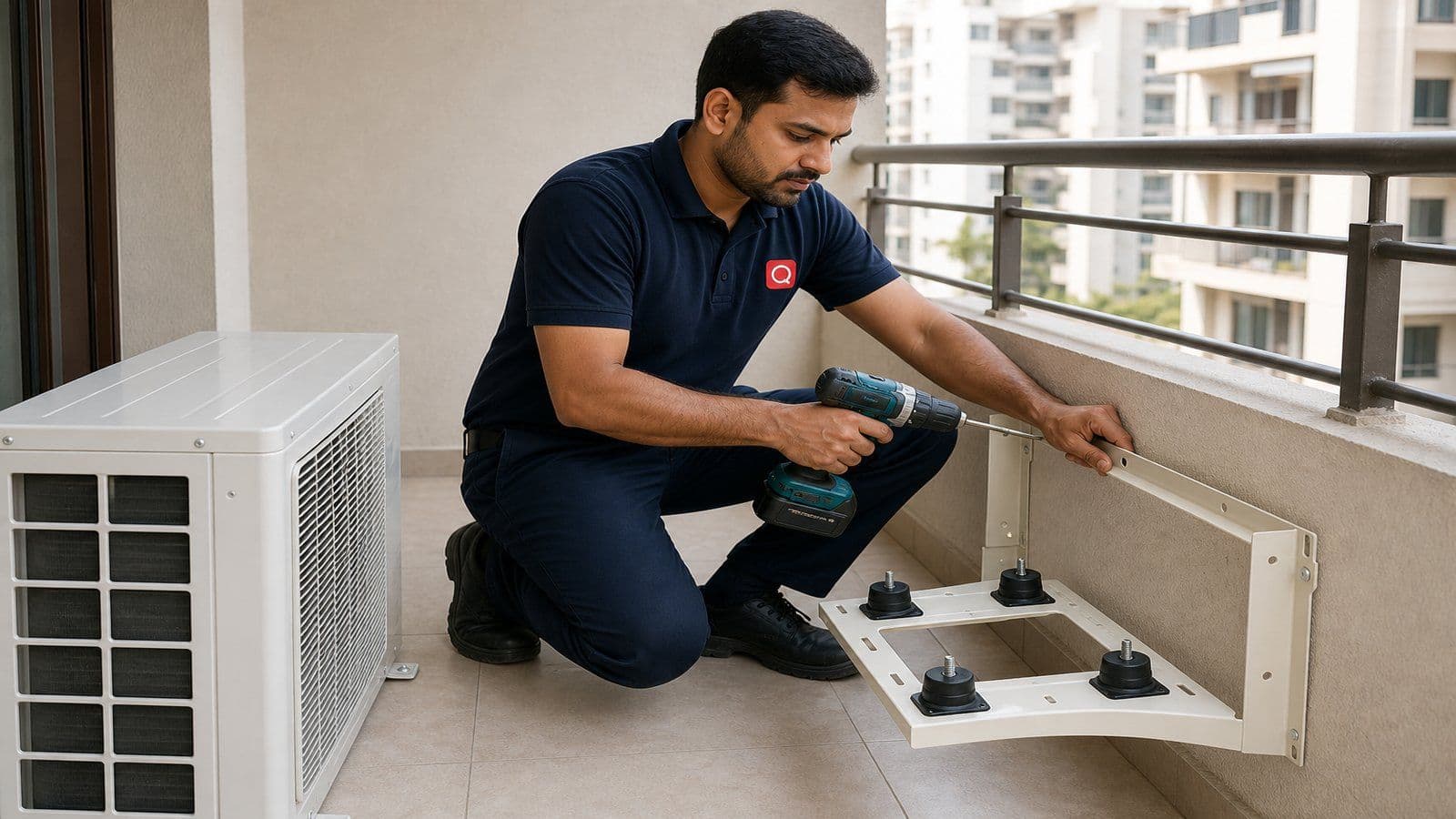
Sixth, check bracket compatibility. The outdoor unit bracket from the old location is rarely the right size for the new wall. Standard L-shaped brackets cost ₹500 to ₹900 in 2026, heavy-duty brackets with concrete anchors run ₹1,200 to ₹2,000. Our AC bracket types and selection guide covers the choice in detail.
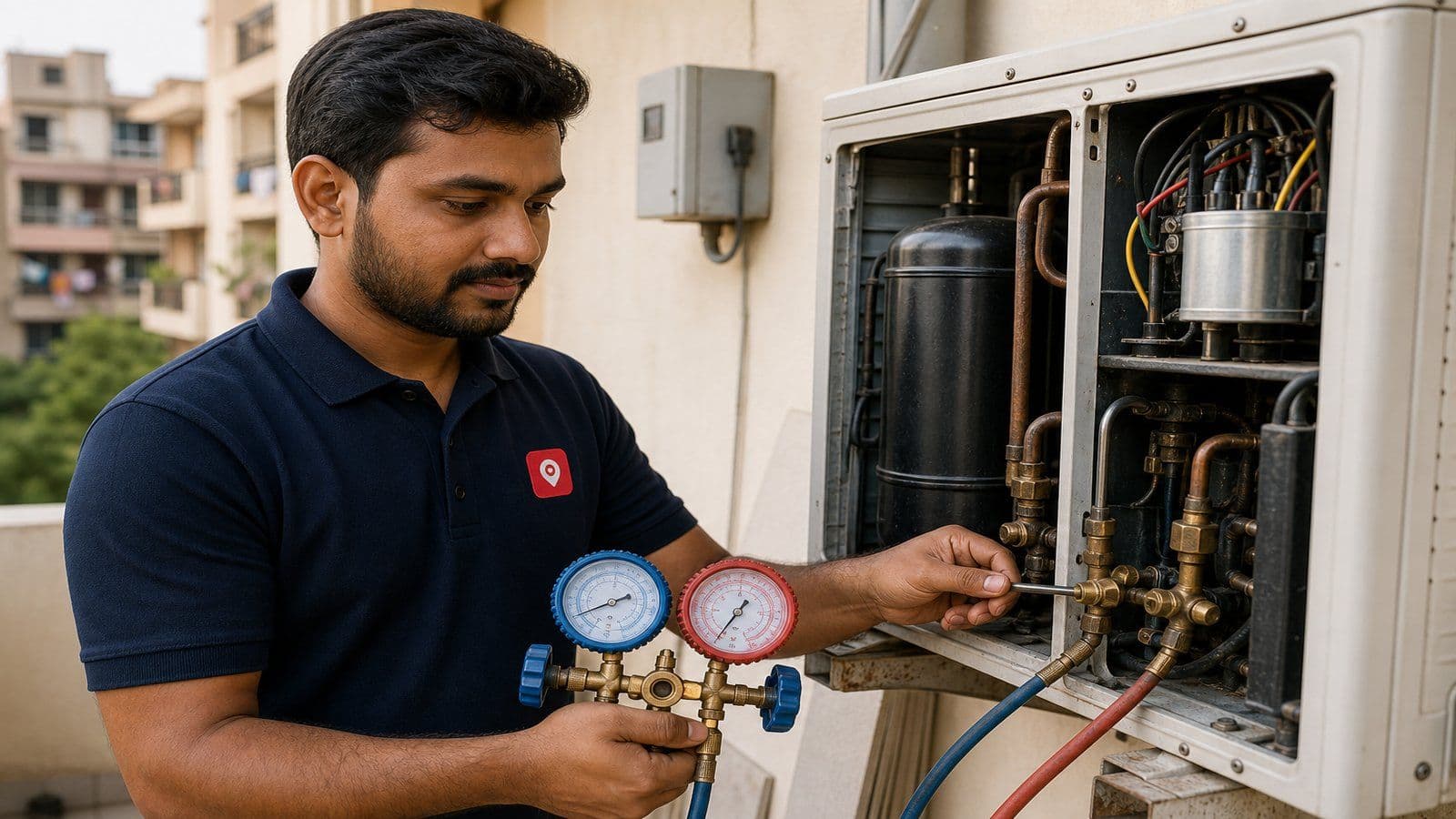
Photo: Pump-down gauge reading at the outdoor service valve
Step by Step: Dismantling at the Old Location
What follows is the exact sequence a certified relocator runs at the old flat. Knowing this lets you spot shortcuts in real time and call them out before damage is done.
Pump-Down
This is the single most important step. Pump-down pulls almost all the refrigerant from the indoor coil and copper lines back into the outdoor unit, where it stays sealed for transport. Without pump-down, opening the flare joints releases the gas charge.
The procedure is short. The unit is switched on in cooling mode at the lowest set temperature so the compressor runs hard. The technician closes the liquid line service valve at the outdoor unit using an Allen key on the valve stem. With the liquid line shut, the compressor pulls refrigerant from the indoor coil and discharges it into the outdoor unit. Within 60 to 90 seconds the suction pressure on the gauge falls to near zero, indicating that almost all the refrigerant is now stored in the outdoor unit. The suction line valve is then closed, the unit is switched off at the remote, and the MCB is killed. If a relocator says pump-down is not needed, refuse the job; it is the single biggest predictor of a failed move.
Electrical Disconnection, Opening Joints and Unmounting
Only after pump-down should anyone touch the wiring. The technician switches off at the MCB, confirms with a voltage tester at the indoor unit terminals, then disconnects the live, neutral, earth and the interconnecting control cable. Each conductor is photographed in position and labelled. The Central Electricity Authority (CEA) wiring rules require a clear visible disconnection before any servicing work.
The flare nuts at both units are then opened slowly with two spanners. There should be a faint hiss as residual pressure equalises, but no large gas release; a large release means pump-down was incomplete. The instant a flare end is exposed, it must be capped with brass or plastic caps on every open port. Two minutes of exposure to humid Indian air during a monsoon-season move is enough to introduce moisture that will need a longer vacuum pull at the new location.
Finally, the indoor unit is lifted off its wall bracket by tilting upward and pulling forward off the lower retaining clips, drain pipe detached, and wrapped in bubble wrap and foam. The outdoor bracket bolts are removed with the unit supported by two people; a 1.5 ton outdoor unit weighs 38 to 52 kg, so this is genuinely a two-person job on any parapet mount.
The single biggest shortcut I catch new technicians taking is rushing the pump-down to under 30 seconds because the customer is hovering and wants the job over. The compressor needs the full 60 to 90 seconds to evacuate the indoor coil properly. Rushed pump-downs leave 200 to 400 grams of refrigerant still in the indoor coil, which then vents when the joints are opened. You only realise the loss when the unit needs a heavy top-up at the new location, by which point the gas is gone and the customer is paying for it.

Get quotes from top-rated pros.
Transport: The Step Where Most Damage Happens
The outdoor unit must be transported upright on its base. This is non-negotiable. The compressor sits in a bath of oil at the bottom of the dome, and the oil is what lubricates the moving parts on every start cycle. Lay the unit on its side or upside down in transit and the oil migrates into the compressor cylinder head. The first start at the new flat then slugs the valves with incompressible oil, which can shatter the discharge valve plate and end the compressor right there.
Three rules for transport. Base down, always. Secure the unit with straps so it cannot tip during sharp turns or speed bumps. Foam padding around the edges to protect the fins and the sheet metal. For same-city moves under 100 km, the ideal is a same-day move. For cross-city moves over 500 km, plan for one full rest day between transport arrival and reinstallation so the compressor oil settles fully before first start.
>Expert Insight from Amit Patel: The single mistake I see most often on cross-city relocations is the packer-mover loading the outdoor unit horizontally to save space in the lorry. The unit arrives intact, the first start seems normal for 20 minutes, then there is a loud knock and the compressor stops. The customer thinks the move broke the AC. Technically yes, but the cause is the oil slug from horizontal transport. We always send a separate vehicle for the AC on any move over 50 km, base-down strapped, foam-padded, and it adds maybe ₹600 to the bill. That ₹600 is the cheapest insurance you will ever buy on a ₹40,000 unit.
>
> Amit Patel, HVAC and Cooling Specialist, ProNearMe verified AC technicians
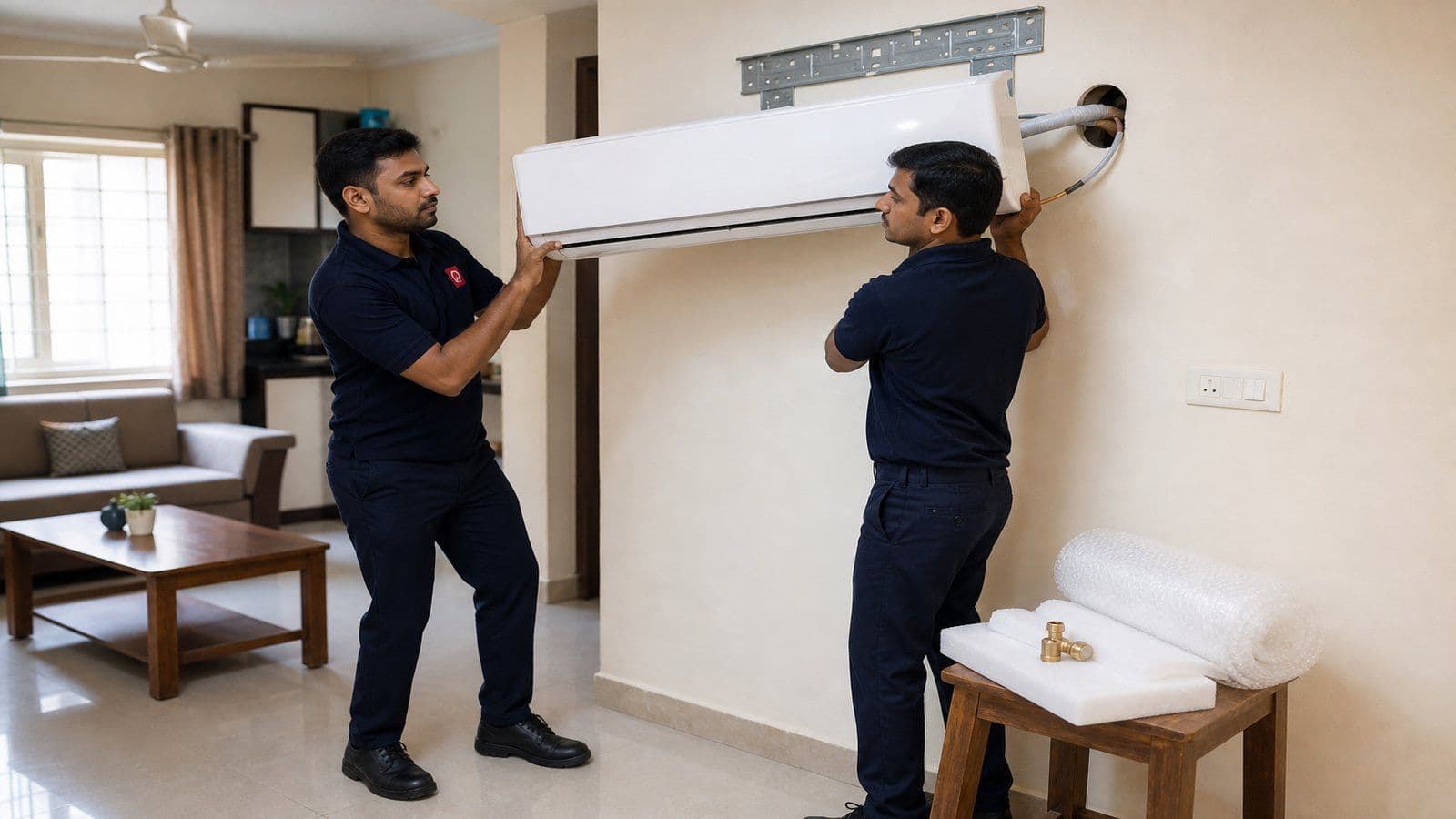
Photo: Technician dismounting an indoor split AC unit
Reinstallation at the New Location
The new flat install follows the same sequence as a fresh install with one important difference: the system already has refrigerant in the outdoor unit, assuming pump-down was done correctly. The job is to connect the lines, evacuate them, open the valves, and verify.
Mounting
The outdoor unit goes on its new bracket first, bolted down with anti-vibration rubber pads between the chassis and the bracket. The indoor unit goes on its wall bracket next, with the drain hose laid into the wall sleeve at a continuous downward slope of at least 1 in 50. Our split AC installation step-by-step guide and split AC outdoor unit placement guide cover the mounting details in full.
Connecting the Copper
If the old copper is being re-used, it is inspected for kinks, insulation damage, brazing burn marks, and flare end condition. Damaged flares are cut off and remade with a flaring tool. The flare nuts are tightened to manufacturer torque (usually 14 to 18 Nm on a 1.5 ton residential split) using a torque wrench. Over-tight cracks the flare; under-tight leaks within days. Sizing rules and BIS-compliant copper specifications are covered in our AC copper pipe specifications and sizing guide.
Vacuum, Leak Test and Verification
A vacuum pump is connected to the service port and run for a minimum of 15 to 20 minutes (longer in humid weather). The gauge should reach 500 microns or lower. The pump is then valved off and the vacuum held for at least 10 minutes with no rise in pressure, confirming the system is leak-tight. Skipping the vacuum step is the second biggest cause of failed relocations; moisture left inside the system produces acid once the compressor runs, and acid kills compressors.
With vacuum confirmed, the technician opens the liquid valve fully with the Allen key, then opens the suction valve. The refrigerant stored in the outdoor unit during pump-down now flows back into the full system. The technician runs the unit in cooling mode and measures supply air temperature, suction pressure, and operating current with a clamp meter. A healthy reinstall on a 1.5 ton inverter split should show a 13 to 15 degree temperature drop at the louvre within 15 minutes of start, a stable suction pressure of 110 to 140 psi for R32, and operating current within nameplate range. If the drop is below 10 degrees or the suction pressure is low, the system may need a small top-up.
A small top-up on a relocated unit is normal. What is a sign of bad work is a relocator who quotes for the top-up upfront in the original estimate. That tells me they know their pump-down is going to be sloppy. Insist that any top-up be measured by weight on a digital scale, with empty and full cylinder weights shown to you. A 1.5 ton unit takes 850 to 1100 grams of R32 from empty. A top-up after relocation should be 50 to 200 grams maximum. Anyone adding more than 250 grams either skipped pump-down completely or has a leak in the new install that needs to be found, not papered over.
When the Copper Pipe Cannot Be Re-Used
Re-using existing copper saves ₹3,000 to ₹6,000 on a typical 4 metre residential run, but it is only safe if the pipe is genuinely sound. Five conditions disqualify the pipe: visible kinks along the length (which restrict flow and cut cooling capacity by 10 to 30 percent), frayed or torn rubber-foam insulation on the suction line, brazing burn marks from a previous repair, copper older than five years that is visibly oxidised on the inside, or runs that need to be longer at the new location than they were at the old. Copper cannot be safely joined mid-run with brazing in a residential install. New copper costs ₹600 to ₹1,200 per metre installed in 2026; a standard 4 metre re-pipe runs ₹2,400 to ₹4,800 total parts and labour.
2026 Cost Benchmarks for AC Relocation
The figures below are typical residential ranges across major Indian cities, exclusive of 18 percent GST, on a standard 1 to 1.5 ton split AC. Window AC relocation is roughly 30 to 50 percent cheaper because there is no pump-down step and no separate outdoor unit to mount.
| Relocation Type | Labour (₹) | Materials Likely (₹) | Total Range (₹) |
| Same-city move with re-used copper | 1,200 to 2,400 | 300 to 1,100 | 1,500 to 3,500 |
| Same-city move with new copper (4 m run) | 1,400 to 2,700 | 2,400 to 4,800 | 3,800 to 7,500 |
| Cross-city move under 500 km with transport | 2,800 to 4,800 | 1,700 to 3,200 | 4,500 to 8,000 |
| Cross-city over 500 km with transport | 3,500 to 6,500 | 1,700 to 3,500 | 5,200 to 10,000 |
| Add: heavy-duty bracket replacement | 600 to 900 | 1,200 to 2,000 | 1,800 to 2,900 |
| Add: vacuum and gas top-up if needed | 400 to 700 | 800 to 1,400 | 1,200 to 2,100 |
| Window AC relocation, same city | 600 to 1,200 | 100 to 500 | 700 to 1,700 |
For the wider new-install cost picture, see our AC installation cost breakdown for India 2026. For pre-install planning at the new location, our new AC day-of-setup checklist covers what to have ready when the relocator arrives. For window AC moves see our window AC installation step-by-step guide.
Get quotes from top-rated pros.
Red Flags in Relocator Quotes
Three phrases tell you immediately that the relocator is not following the safe procedure. Walk away the moment you hear any of them.
No Pump-Down Needed
There is no scenario where a residential split AC can be relocated safely without pump-down (or a refrigerant recovery machine, which is rare in the residential trade). "No pump-down needed sir, we will open the joint quickly" means the gas is going into the atmosphere, you are paying for a full re-charge at the new flat, and the MoEF&CC violation is on the relocator but the broken AC is on you.
We Re-Use the Old Gas
The refrigerant sealed in the outdoor unit during transport is what you have at the new location; there is no separate paid "old gas re-use" step. Anyone offering it either does not understand the process or intends to vent and recharge.
No Leak Test or Vacuum Required
The vacuum and leak test step is what removes moisture and verifies the joints are tight. Skipping it saves the relocator 20 minutes and costs you a compressor within 12 months. Insist on seeing the vacuum gauge reach 500 microns or lower, held for 10 minutes. If the technician arrives without a vacuum pump and gauge, send them home.
Warranty Implications and What to Document
Almost every major Indian AC brand has the same condition in fine print: relocation must be carried out by the brand's authorised service centre or by a documented NSDC-certified technician, with a service report on file, or the manufacturer warranty is void. A compressor failure at year three on a five-year warranty saves you ₹18,000 to ₹35,000 if the warranty is intact and costs you that same amount if it is not.
The Press Information Bureau (PIB) consumer advisories have flagged unauthorised AC relocation as a growing source of warranty disputes, and the Bureau of Indian Standards (BIS) has published guidance under IS 1391 on what constitutes a competent relocation. Either use the brand's own service centre, or use a relocator who can produce an NSDC certification number and a signed service report. Keep the report, the bill, and before-and-after photographs in the warranty folder. For installation mistakes to avoid that often surface during relocation, see our AC installation mistakes checklist. For out-of-warranty units, the certification still matters because of MoEF&CC refrigerant rules under the Kigali Amendment, which require anyone handling R32, R410A or R22 to hold an NSDC-recognised certification.
Case Study from a Cross-City Relocation Done Right
Mrs. Kavita Iyer moved from Powai, Mumbai to Whitefield, Bengaluru in March 2025 with her three-year-old 1.5 ton inverter split AC. The packers-and-movers company quoted ₹1,200 to include the AC in the general move. She booked the AC separately through ProNearMe at ₹6,800 inclusive of transport and reinstall.
The Mumbai-side technician arrived with a pressure gauge manifold and a vacuum pump. He ran the unit on cooling for ten minutes to warm the system, then executed pump-down: liquid valve closed, suction pressure dropped from 130 psi to near zero in 72 seconds, suction valve closed, unit off, MCB off. He labelled the four electrical conductors, capped all four flare ends with brass caps, and wrapped the outdoor unit's exposed valves in self-amalgamating tape. The copper was inspected as re-usable. Both units were foam-wrapped and loaded base-down into a dedicated AC transport van.
Forty-eight hours later in Bengaluru, the local technician mounted the outdoor unit on a new heavy-duty bracket on the third-floor balcony, reconnected the copper after re-flaring both indoor-side ends, ran a 22-minute vacuum to 380 microns, held for 11 minutes with zero rise, opened the valves, and verified operation. Supply air dropped 14.2 degrees in the first 18 minutes. A 90 gram top-up was added to compensate for the small loss during dismantling, measured by digital scale. Total bill including transport, ₹7,150 inclusive of GST. The unit has run normally for the 14 months since.
Conclusion
An AC relocation is a small technical job that is repeatedly wrecked by people who treat it like a furniture move. The procedure is well-defined: pump-down, careful dismantle, upright transport, vacuum-and-leak-test reinstall, verify operation. Every step has a reason and skipping any of them costs more than doing the job correctly in the first place. The honest truth is that the certified relocator who quotes ₹3,000 and takes four hours is almost always cheaper than the handyman who quotes ₹800 and takes two, once you count the repair bill that follows.
The fastest path to a clean move is to book the AC separately from the household move, insist on an NSDC-certified technician with a vacuum pump and pressure gauge, confirm pump-down will be done, and keep the service report in your warranty folder. Three preventive habits will save the AC: photograph the existing install before anyone touches it, transport the outdoor unit base-down with straps, and verify the supply-air temperature drop at the new location before signing off. Owners who follow this discipline see their relocated ACs run normally for the rest of the original design life, and our ProNearMe network data shows zero compressor failures within 18 months on jobs that documented all three preventive steps.
Disclaimer
All relocation cost ranges in this guide are typical residential figures across major Indian cities and exclude GST, currently 18 percent on most AC service and parts in India. Actual costs vary by city, transport distance, copper pipe condition, bracket compatibility, and access difficulty at the new location (high floors without lift access, narrow stairwells, and parapet mounts carry higher labour charges). We strongly recommend hiring only NSDC-certified or OEM-authorised technicians for any AC relocation, since the work involves regulated refrigerant handling under MoEF&CC rules, electrical disconnection covered by Central Electricity Authority guidelines, and warranty conditions set by each manufacturer. ProNearMe does not endorse any specific AC brand and the relocation process in this guide applies across all residential air conditioner manufacturers sold in India.
Sources & References
- Bureau of Energy Efficiency Air Conditioner Standards and Labelling Programme
- Bureau of Indian Standards IS 1391 Room Air Conditioner Performance Standard
- Ministry of Environment, Forest and Climate Change Ozone Cell and Kigali Amendment Implementation
- National Skill Development Corporation HVAC Technician Qualification Pack
- Indian Society of Heating, Refrigerating and Air Conditioning Engineers Residential HVAC Guidelines
- Press Information Bureau Consumer Advisory on AC Service and Relocation
- Central Electricity Authority Wiring and Safety Regulations for Domestic Installations
- Indian Plumbing Association Condensate Drain and HVAC Guidelines
- Ministry of Power Energy Conservation Building Code (ECBC) Residential
- National Building Code of India Part 8 Building Services Air Conditioning Heating and Mechanical Ventilation
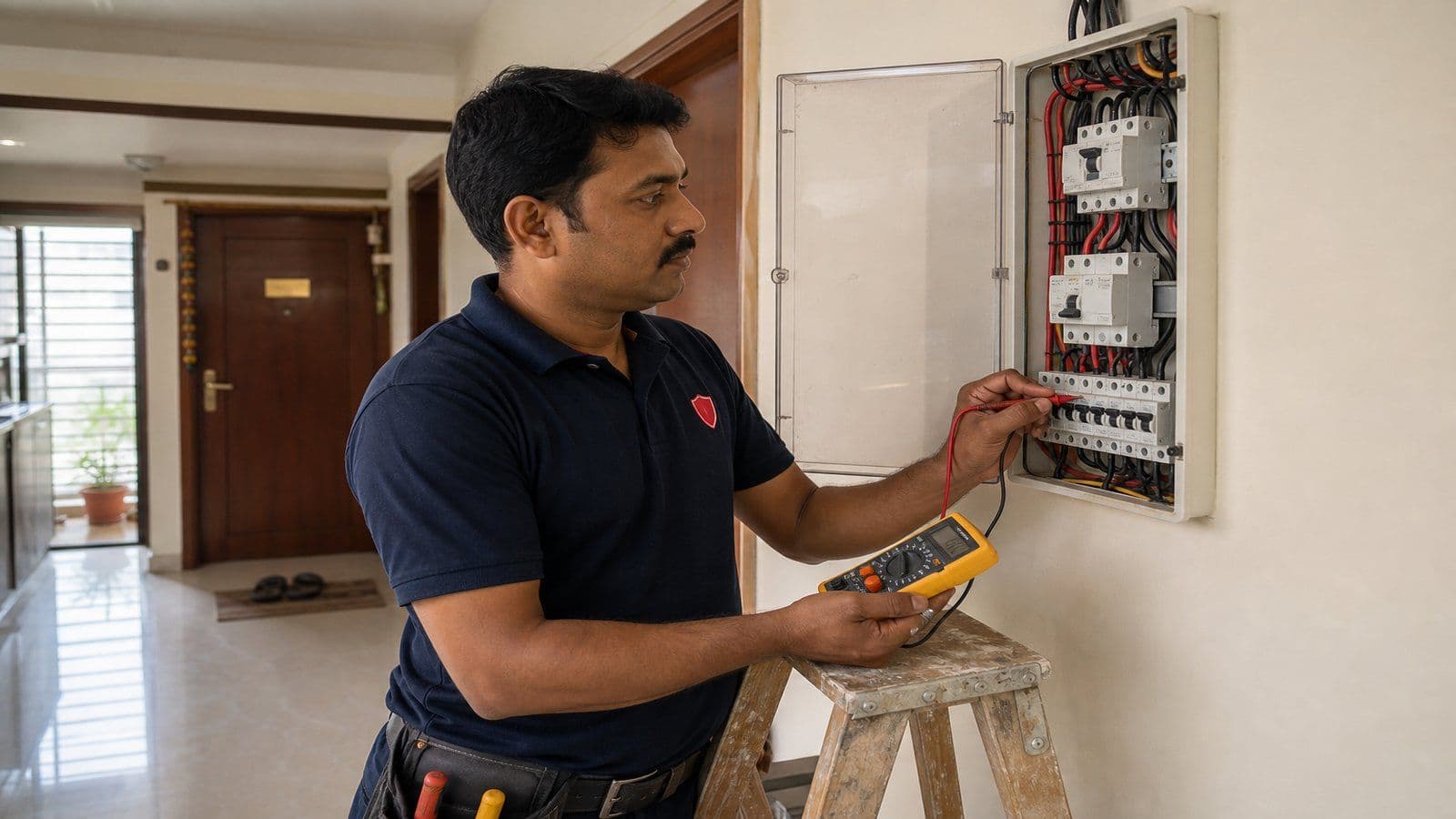
Amit worked as an AC technician for 6 years in Ahmedabad before transitioning to technical writing. He holds a diploma in Refrigeration and Air Conditioning from ITI Ahmedabad and understands the difference between what AC companies promise and what actually happens on the ground. His articles break down complex technical topics into plain language that any homeowner can follow. He tests every tip he writes about in his own home first.

Dr. Verma is a mechanical engineer with 15 years of experience in HVAC systems. She completed her PhD from IIT Delhi on energy-efficient cooling solutions for Indian residential buildings. She reviews all technical content on HomePros to make sure the numbers are right, the advice is safe, and the recommendations are backed by actual engineering principles. She consults for multiple AC manufacturers on product design.