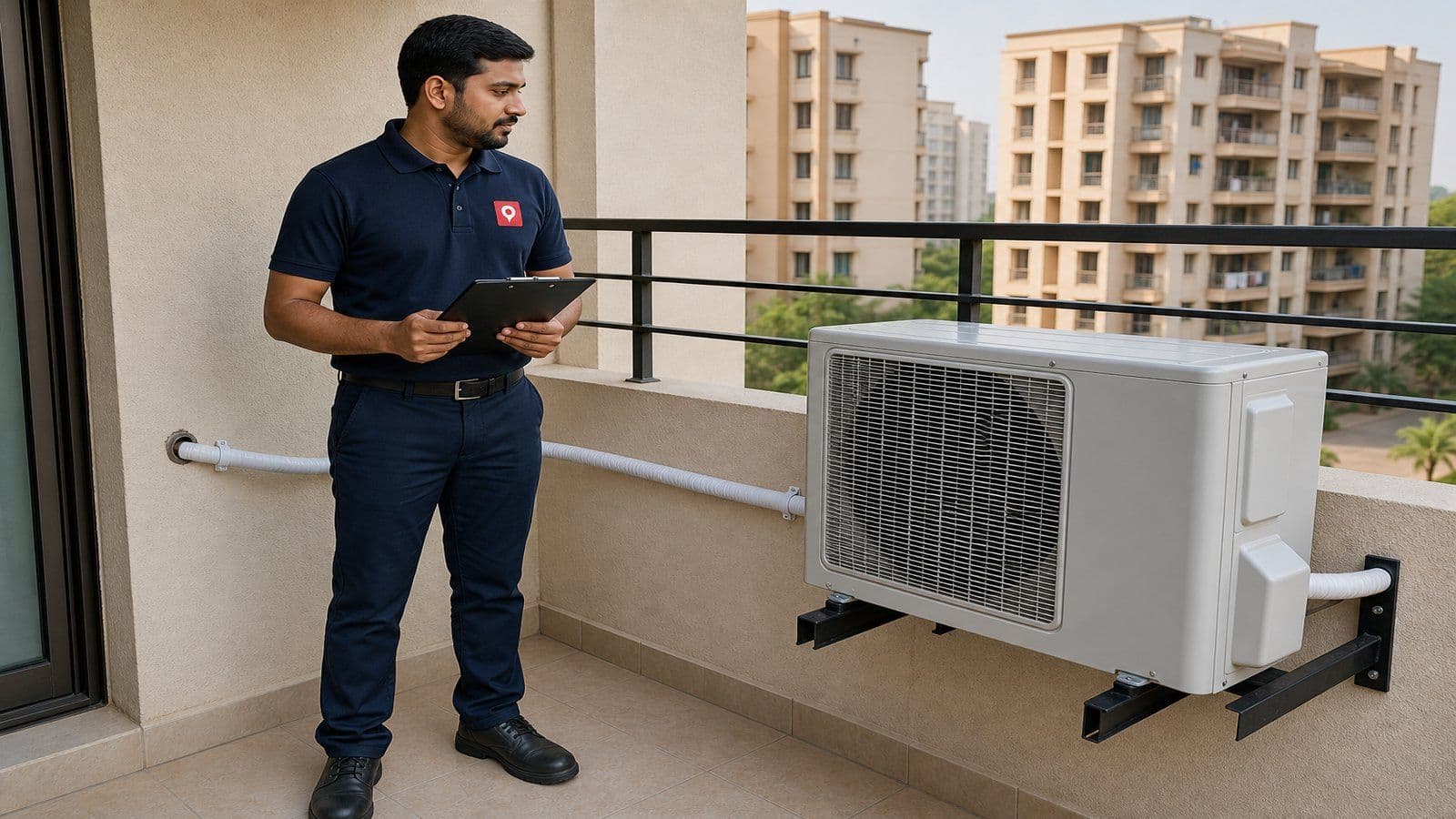
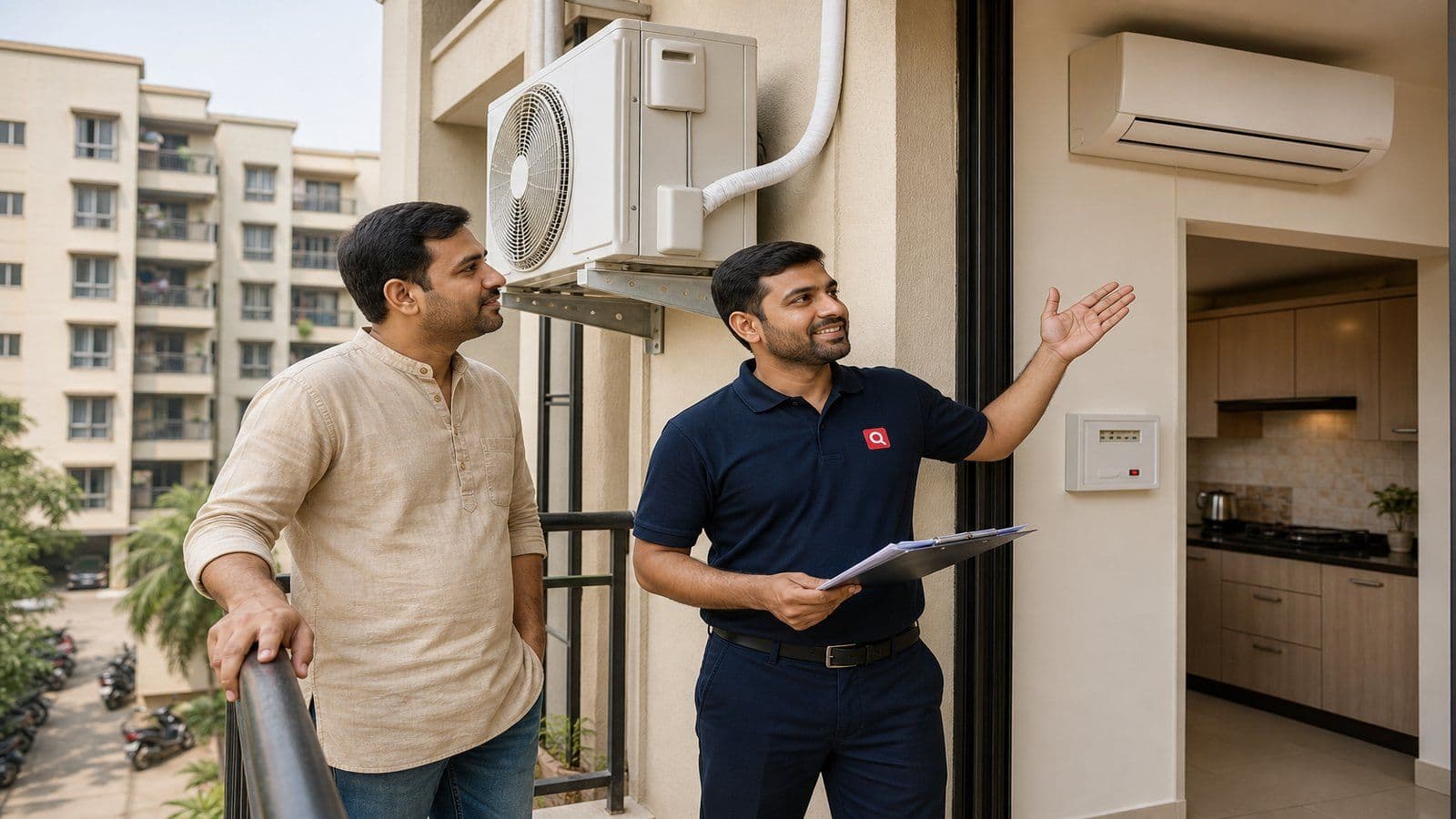
- The verified AC technicians in our ProNearMe network report that 38 percent of outdoor-unit complaints in coastal cities trace back to bracket corrosion rather than the AC itself, almost always on units fitted with the cheapest painted mild-steel bracket.
- A 1.5 ton split AC outdoor unit weighs 38 to 48 kg dry plus continuous vibration load BIS guidance recommends a bracket static rating of at least 1.5 times unit dry weight.
- Powder-coated MS is the sweet spot for inland Delhi, Bengaluru and Hyderabad at 12 to 15 years of life For coastal Mumbai, Chennai and Kolkata, hot-dip galvanised or SS304 is the only honest recommendation.
- Vibration-damping mounts (neoprene or polyurethane bushings) are mandatory on parapet installs, shared walls and societies enforcing noise transfer rules.
- Bracket replacement is never DIY Budget ₹3,500 to ₹7,500 in labour plus bracket cost for unit dismount, refrigerant recovery, re-anchoring and vacuum-and-recharge.
The ac bracket is the single most undervalued part of a split AC installation. Owners spend weeks comparing inverter brands and BEE star ratings, then leave the bracket choice to whoever the dealer's installer favours.
The result is a 45 kg outdoor unit hanging off a coastal Mumbai parapet on a painted mild-steel bracket that will rust through in four monsoons.
Amit has spent 14 years across 2,800+ service calls in Mumbai, Pune and Hyderabad. Bracket failures account for nearly one in nine outdoor-unit complaints our team logs post-monsoon.
This guide covers the five bracket types sold in India in 2026, sizing by AC tonnage, wall-anchor specs under BIS load codes, and the climate rules separating a 25-year coastal install from a 5-year liability. For wider install context, see the parent pillar on AC installation complete guide.

Get quotes from top-rated pros.
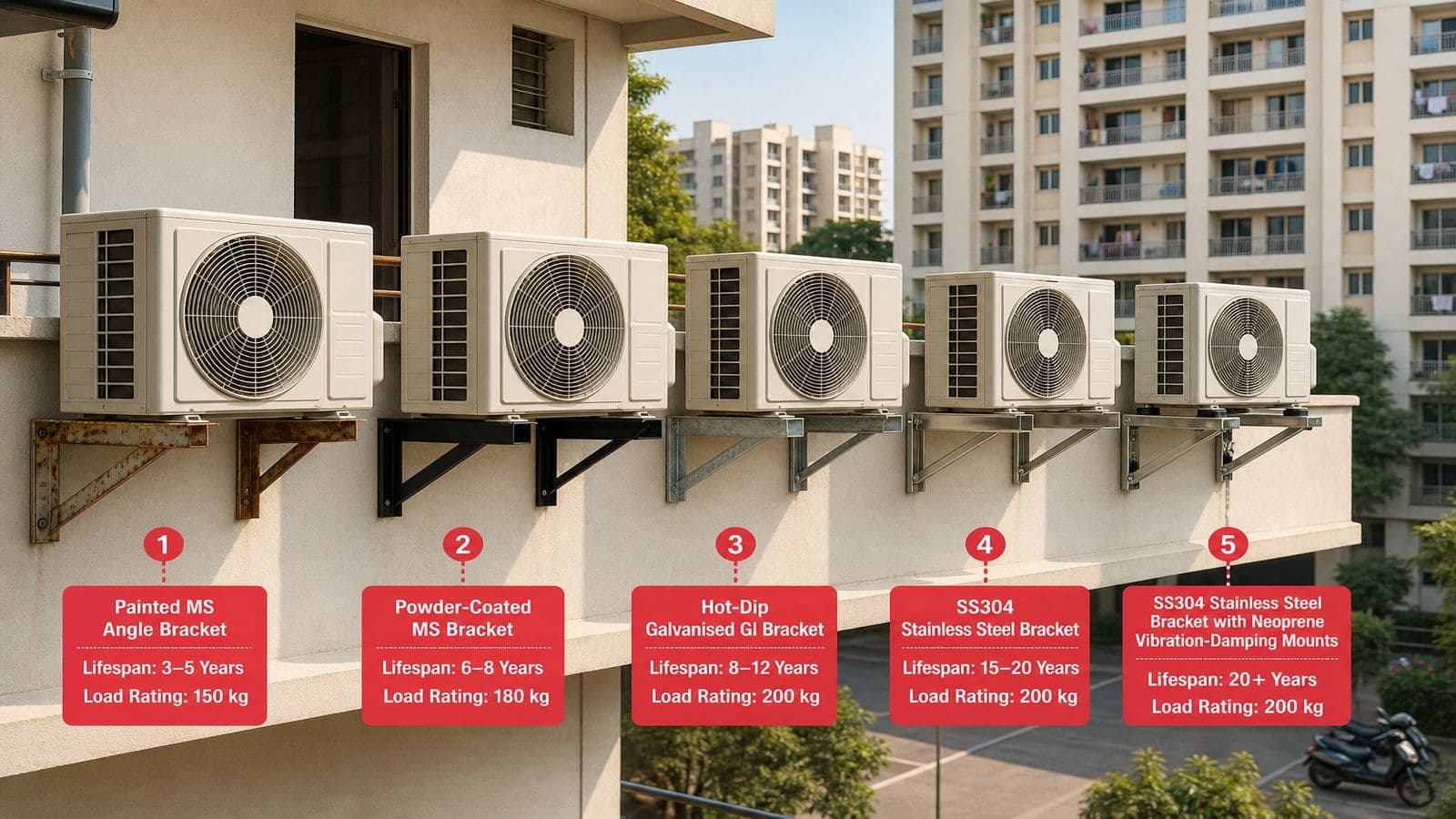
Photo: Five AC Bracket Types Comparison Lineup
Why Bracket Choice Matters
The bracket carries four loads at once: static weight from a 40 to 48 kg outdoor unit, dynamic vibration from compressor cycling, wind loading (a 600 mm wide unit acts as a small sail in a Mumbai pre-monsoon squall), and corrosion from salt-laden coastal air, NCR pollution and acid rain.
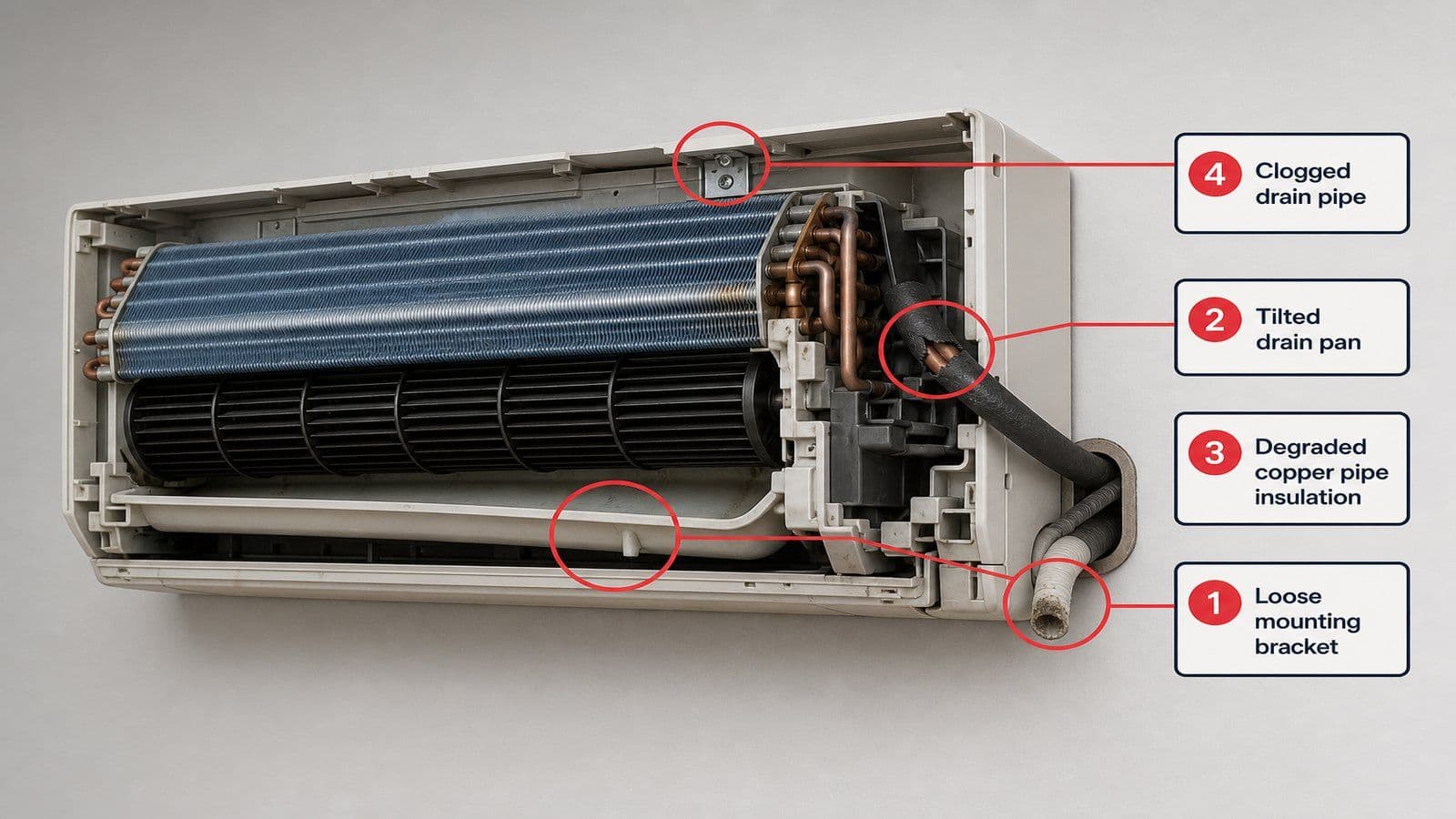
A failure does not announce itself politely. It begins as a hairline crack at a weld point, runs unseen for a season, then on one humid August morning the unit tilts ten degrees forward, the copper pipes kink, refrigerant pressure spikes, and the compressor trips on high-pressure cut-out. Our network has logged three falling-unit incidents in 18 months in Mumbai alone, all on painted mild-steel brackets aged six years or more.
Bureau of Indian Standards (BIS) IS 875 part 3 sets wind-load criteria for buildings but does not directly cover AC brackets. The Indian Society of Heating, Refrigerating and Air Conditioning Engineers (ISHRAE) residential install guidance recommends a factor of safety of 2x dry unit weight, but dealer enforcement is non-existent. The realistic guard is the customer asking the right question before install day.
The Five Bracket Types Sold in India in 2026
MS Angle Painted Bracket
The default in budget installs. Mild-steel angle iron welded into an L-shape, then painted in factory enamel. ₹450 to ₹900 for a 1.5 ton frame. Life 5 to 7 years coastal, 8 to 10 inland. Paint cracks at weld joints within the first monsoon, water seeps under, and by year four the rust bloom is structural. Useful only where the customer accepts early replacement.
Powder-Coated MS Bracket
The most widely recommended bracket for inland tier-1 cities. Same mild-steel frame with epoxy or polyester powder-coat, electrostatically sprayed and oven-cured. Resists chipping for 10 to 15 years inland. ₹900 to ₹1,800. Look for uniform coat thickness, no powder runs at welds, and end-caps on every open tube section to prevent water pooling inside the frame.
Hot-Dip Galvanised (GI) Bracket
The honest coastal-city bracket. Frame dipped in molten zinc at around 450 degrees, bonding a 60 to 80 micron zinc layer across every surface. Zinc both protects and acts as a sacrificial anode, so a scratch still does not start rust. Life 20 to 25 years inland, 15 to 20 coastal. ₹1,800 to ₹3,500. Genuine GI shows a crystalline or spangled surface, very different from the smooth sheen of powder coating.
SS304 Stainless Steel Bracket
The premium coastal option. Built from 304-grade stainless steel angle. Chromium forms a passive oxide layer that self-repairs when scratched. Life 25 years plus. ₹3,500 to ₹6,500. Right choice for sea-facing flats above the eighth floor, high-rise balconies needing scaffolding for future work, and any once-and-done specification. Grade marking is stamped on the frame, often as 304 or 18/8.
Vibration-Damping Bracket
Adds neoprene or polyurethane bushings between outdoor unit feet and bracket cross-bar. Upcharge ₹400 to ₹1,200. Isolates compressor vibration from the wall, preventing the rumble that programmes hairline cracks in plaster over 18 to 24 months. Mandatory on parapet installs over a shared wall, societies with noise-transfer by-laws, and any install directly above a bedroom window below.
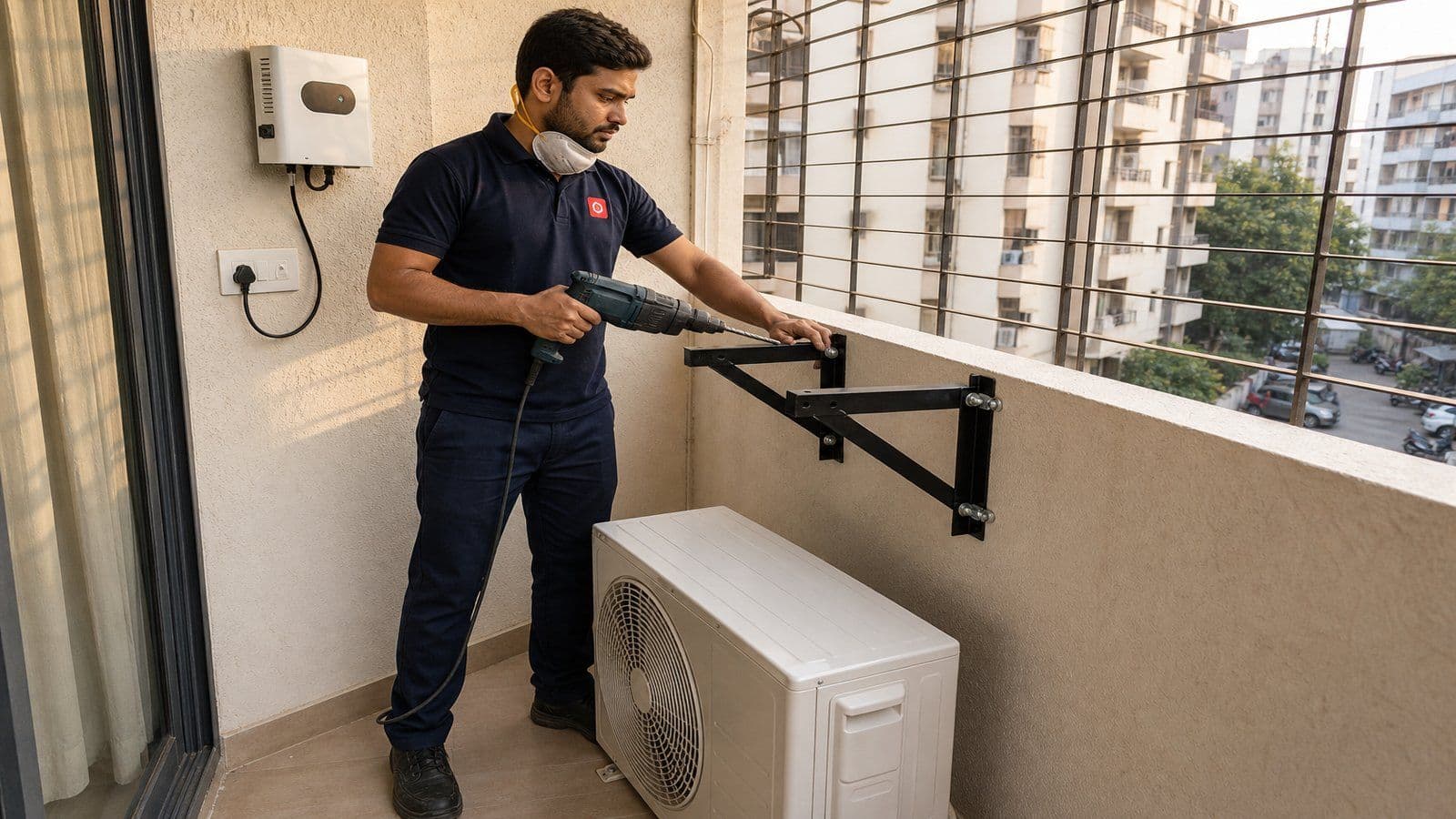
Photo: Technician Installing Powder-Coated Bracket on Apartment Wall
Sizing the Bracket Against Your AC Tonnage
ISHRAE working rule: 1.5x factor of safety over dry outdoor-unit weight. A bracket bought exactly at unit weight goes undersized within three to four monsoons once corrosion and vibration capacity-loss are factored in. Always go the next rating up; the cost difference is rarely more than ₹300.
Get quotes from top-rated pros.
| AC Tonnage | Dry Weight (kg) | Min Bracket (kg) | With Mounts |
| 0.8 to 1 ton | 25 to 32 | 50 | 60 neoprene |
| 1.5 ton | 38 to 48 | 60 | 75 neoprene |
| 2 ton | 50 to 65 | 80 | 100 polyurethane |
| 2.5 ton | 65 to 80 | 100 | 120 polyurethane |
| 3 ton | 80 to 100 | 130 | 160 polyurethane |
On bracket calls in coastal Mumbai, the first question is not what bracket but what floor. Anything above the seventh floor in a sea-facing flat needs SS304, full stop. We have replaced GI brackets on Bandra and Worli sea-facing flats at year eight that looked sound from the floor but had lost forty percent of wall-thickness once we pulled them down. The GI to SS304 cost difference at install is ₹2,500. At replacement with scaffolding on an upper floor, it can run ₹15,000.

Wall-Anchor Specifications That Actually Matter
The bracket is only as strong as its anchors. This is the most common shortcut by budget installers and the most common cause of catastrophic failure in our incident logs.
Minimum anchor for any 1 to 2 ton residential bracket is M10 mechanical expansion or chemical resin at 75 mm embedment into solid brick or concrete. M8 does not give adequate pull-out resistance, reject it. M12 is required for 2.5 ton and above. Hollow brick walls (common in newer Gurugram, Noida and Bengaluru construction) need chemical resin anchors with longer embedment. Plaster-only is never acceptable. The Central Electricity Authority (CEA) requires an RCCB on residential AC circuits. The Indian Plumbing Association (IPA) and National Building Code (NBC) of India volume 2 cover anchoring guidance generally.
Verify the four-point check on install day:
- Four anchor points minimum per single-bracket install (2 ton plus needs six on a triangulated double bracket).
- Embedment depth visible at the drill phase, the technician marks the drill bit and you watch it sink to the mark.
- Anchor tension test, torque the M10 nut to spec (typically 35 to 45 Nm), no creak from the wall.
- No mortar joint anchors, the anchor must go into brick or concrete body, not the mortar between bricks.
Window AC Bracket Versus Split AC Bracket
A window AC bracket is a sleeve-and-cradle supporting the whole chassis (35 to 55 kg for a 1 to 1.5 ton class) along its full base, with a 2 degree drainage tilt. Sleeve depth must match unit depth within 25 mm; sill engagement must cover at least 75 percent of unit width.
A split AC outdoor-unit bracket is an L-frame or triangulated design where the outdoor unit sits on a cross-bar resting on the L. Load concentrates at four feet mounting points; the unit must sit level. For owners replacing a window AC with a split, the old bracket is useless; specify a new outdoor-unit bracket.
Climate-Specific Bracket Selection
| Location Profile | Minimum | Best Choice |
| Inland tier-1 (Delhi, Bengaluru, Hyderabad, Pune) | Powder-coated MS | Hot-dip GI for upper floors |
| Inland NCR high pollution (Faridabad, Noida) | Hot-dip GI | Hot-dip GI with vibration mounts |
| Coastal (Mumbai, Chennai, Kolkata, Kochi) | Hot-dip GI | SS304 for sea-facing flats |
| Sea-facing above 7th floor | SS304 | SS304 with polyurethane mounts |
| Hill stations (Shimla, Ooty) | Powder-coated MS | Hot-dip GI for monsoon zones |
The highest-risk profile in our complaint logs is the upper-floor sea-facing Mumbai or Chennai flat on a powder-coated MS bracket. These fail consistently between year five and seven. The realised cost of an early failure on an upper-floor coastal flat is typically four to six times the original install-day upgrade cost.
When we audit a builder-handover flat in Bengaluru or Pune for AC retrofit, the existing bracket gets removed nine times out of ten. Builder installs use the cheapest painted MS bracket with M8 or smaller anchors, sometimes set into mortar joints rather than brick. Customers assume the builder used trade-standard hardware. They almost never do, because bracket cost is below the threshold the customer notices on the handover bill.
Vibration Mounts in Detail
A split AC compressor cycles 12 to 25 times an hour during peak summer; each cycle launches a low-frequency vibration into bracket and wall. Without damping, vibration transmits through shared walls, programmes hairline cracking in plaster over 18 to 24 months, and on parapet installs can loosen anchor bolts.
Neoprene bushings are standard: a 20 mm rubber puck with steel through-bolt, 8 to 12 years life, ₹120 to ₹240 per puck. Polyurethane is the upgrade, stiffer, holds isolation longer (12 to 15 years), better UV resistance for unshaded balconies, ₹250 to ₹450 per puck.
Two install rules matter. Mounts must be compressed but not crushed; torque the through-bolt to spec (18 to 25 Nm), an over-tightened bushing transmits more vibration than no bushing. And the unit must sit on all four bushings evenly. Pune, Bengaluru and Gurugram societies increasingly enforce AC noise rules under the Noise Pollution (Regulation and Control) Rules notified by MoEF&CC.
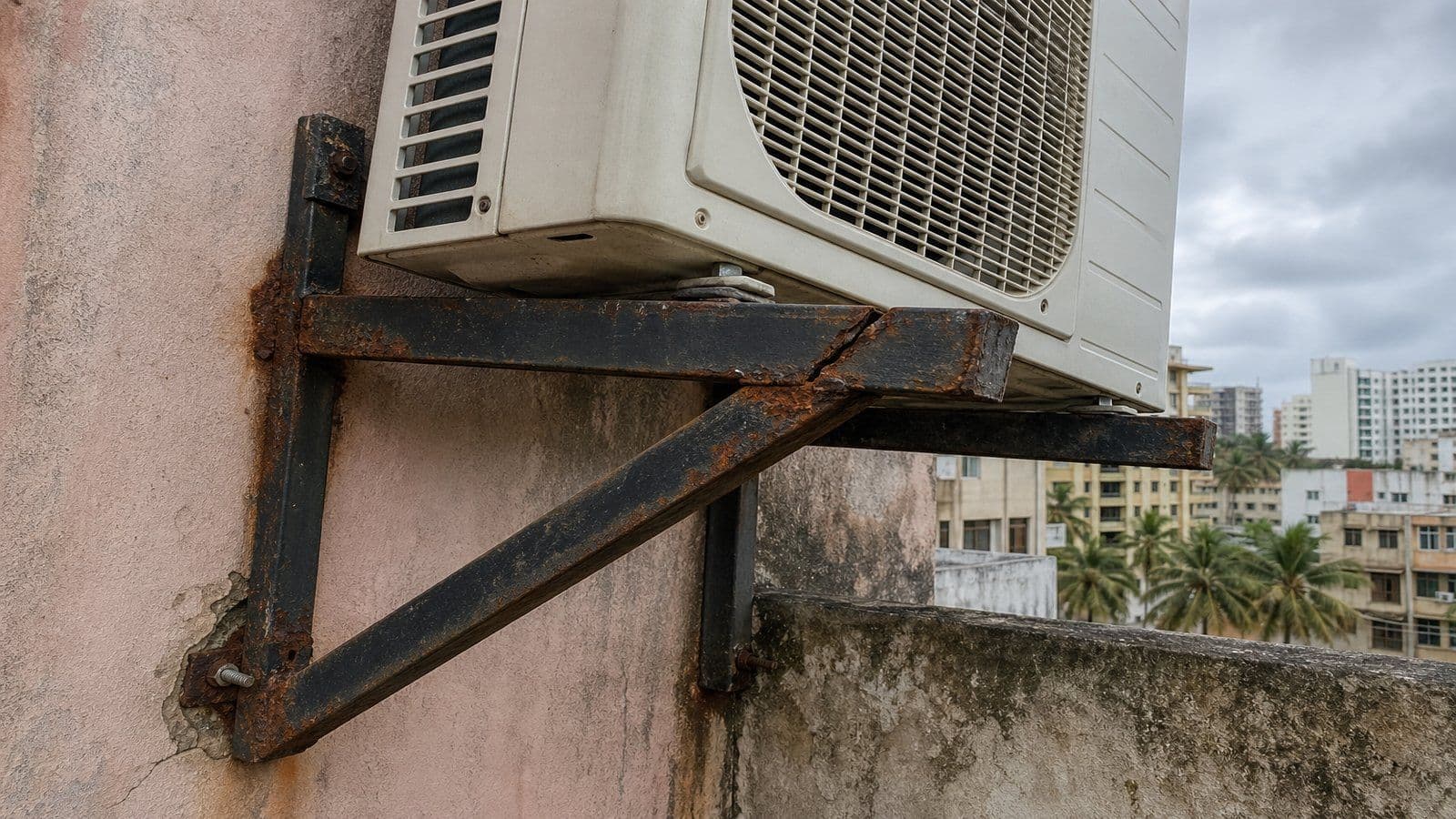
Photo: Failed Painted MS Bracket on Coastal Apartment
Typical 2026 Bracket Pricing
The figures below are typical residential prices across major Indian cities, exclusive of 18 percent GST, for a 1 to 1.5 ton split AC outdoor-unit bracket from a reputable OEM. Generic options trade at a 25 to 40 percent discount but carry no realistic warranty.
Get quotes from top-rated pros.
| Bracket Type | Only (₹) | With Mounts (₹) | Labour (₹) | Lifespan |
| MS Angle Painted | 450 to 900 | 850 to 1,500 | 700 to 1,200 | 5-7 yr coastal, 8-10 inland |
| Powder-Coated MS | 900 to 1,800 | 1,300 to 2,600 | 700 to 1,200 | 10 coastal, 12-15 inland |
| Hot-Dip GI | 1,800 to 3,500 | 2,300 to 4,500 | 800 to 1,400 | 15-20 coastal, 20+ inland |
| SS304 | 3,500 to 6,500 | 4,000 to 7,500 | 900 to 1,500 | 25+ any climate |
Replacement labour runs higher than first-fit because the unit must be dismounted, refrigerant recovered, new bracket anchored, unit re-mounted with full vacuum-and-recharge. Budget ₹3,500 to ₹7,500 for labour alone.
Bracket Failure Signs and Replacement Timing
Four signs trigger a same-week inspection. Rust bloom at weld joints means the coating has cracked and water is reaching bare steel; on a painted bracket, plan replacement within 12 months coastal. Hairline cracking at any weld is non-negotiable, cracks propagate quickly under vibration. Bracket movement against the wall when pressed sideways indicates anchor loosening. Unit tilt beyond 1 degree on the long axis means lower anchors have loosened.
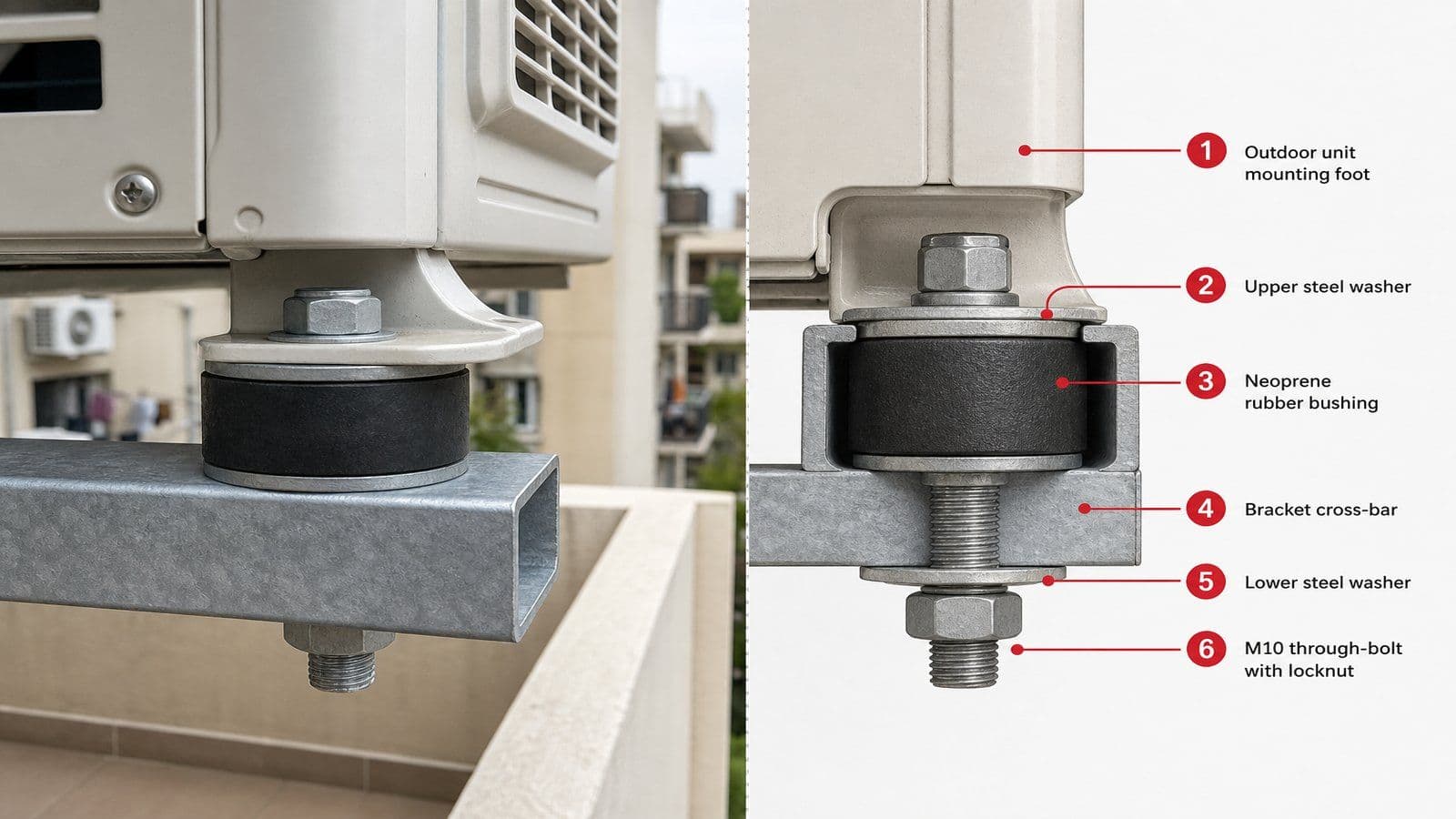
Photo: Vibration-Damping Mount Close-Up Cutaway
DIY Versus Technician
Bracket replacement is technician-only. Safe dismount needs two trained people, a lifting harness on upper floors, and the strength to handle 40 to 65 kg on a balcony. Any work breaking the refrigerant circuit requires NSDC certification under MoEF&CC rules implementing the Kigali Amendment. Anchoring needs a calibrated hammer drill, the right anchor for the wall, and torque verification.
The owner's role is specification, supervision, and acceptance. Sourcing a bracket separately and asking a generic handyman is a false economy. For wider install planning see split AC installation step-by-step, window AC installation step-by-step, outdoor unit placement and society approval for AC installation.
The mistake we see most often on replacement quotes is the technician quoting only bracket and labour, leaving out refrigerant recovery and the vacuum-and-recharge cycle. Then on site, the customer is hit with a ₹3,000 to ₹4,500 add-on for the gas work. Insist the quote itemises recovery, vacuum, and recharge. If the technician says it is not needed, walk away, because that means he is planning to vent refrigerant to atmosphere, a notifiable offence under MoEF&CC rules.
Case Study from a Bandra Sea-Facing Bracket Failure
Mrs. Priya Krishnan, a customer in Bandra West, Mumbai, called our network in September 2025 about her 1.5 ton split AC outdoor unit that had tilted forward overnight. The flat was on the eleventh floor of a sea-facing tower. The 2019 install used a powder-coated MS bracket and M8 anchors.
Our technician supported the unit from below with an emergency strap within four hours. A 4 cm crack had opened along the weld where the cross-bar met the L-frame, the cross-bar had dropped 8 mm, and the lower-left M8 anchor had pulled 3 mm out of the wall. Continued operation would have dropped the 44 kg unit within 48 hours.
Replacement used SS304 with polyurethane mounts and M10 chemical resin anchors at 90 mm embedment. Total ₹14,800 inclusive of GST: ₹5,200 bracket, ₹1,400 mounts, ₹6,200 two-technician labour with refrigerant recovery and vacuum-and-recharge, ₹2,000 scaffold rental. The 2019 builder bracket had cost ₹650. Realised cost of saving ₹4,000 at install day was ₹14,150.
Conclusion
The AC bracket is a quiet load-bearing decision owners make once, often without realising it, and that quietly drives the seven-year service experience and total cost of ownership. The five types above, painted MS, powder-coated MS, hot-dip GI, SS304, and the vibration-damping overlay, cover every residential scenario in India. The right choice is almost always knowable in advance from climate, tonnage and access. Saving ₹2,000 at install day routinely costs four to six times more at the first replacement.
The two preventive habits cost almost nothing. The four-point anchor check on install day takes the installer five extra minutes. The yearly visual inspection from the balcony catches every realistic failure mode months before it becomes catastrophic. The Press Information Bureau and National Building Code both recognise structural element inspection as a basic homeowner responsibility; a bracket carrying 40 to 65 kg on an external wall qualifies.
Disclaimer
All pricing reflects typical residential ranges across major Indian cities exclusive of 18 percent GST, which applies on most bracket components and labour. Costs vary by city, brand, access difficulty, and wall-material anchor specification. Hire only NSDC-certified or OEM-trained technicians for bracket work involving the refrigerant circuit, since these involve regulated MoEF&CC compliance and significant safety risk. ProNearMe does not endorse any specific bracket or AC manufacturer.
Sources & References
- Bureau of Indian Standards IS 875 Part 3 Wind Loads on Buildings and Structures
- Bureau of Energy Efficiency Air Conditioner Standards and Labelling Programme
- Ministry of Environment, Forest and Climate Change Ozone Cell and Kigali Amendment Implementation
- National Skill Development Corporation HVAC Technician Qualification Pack
- Indian Society of Heating, Refrigerating and Air Conditioning Engineers Residential HVAC Guidelines
- National Building Code of India Volume 2 Part 6 Structural Design
- Central Electricity Authority Wiring and Safety Regulations for Domestic Installations
- Press Information Bureau Advisory on Residential Building Maintenance Practices
- MoEF&CC Noise Pollution Regulation and Control Rules
- Ministry of Power Energy Conservation Building Code Residential
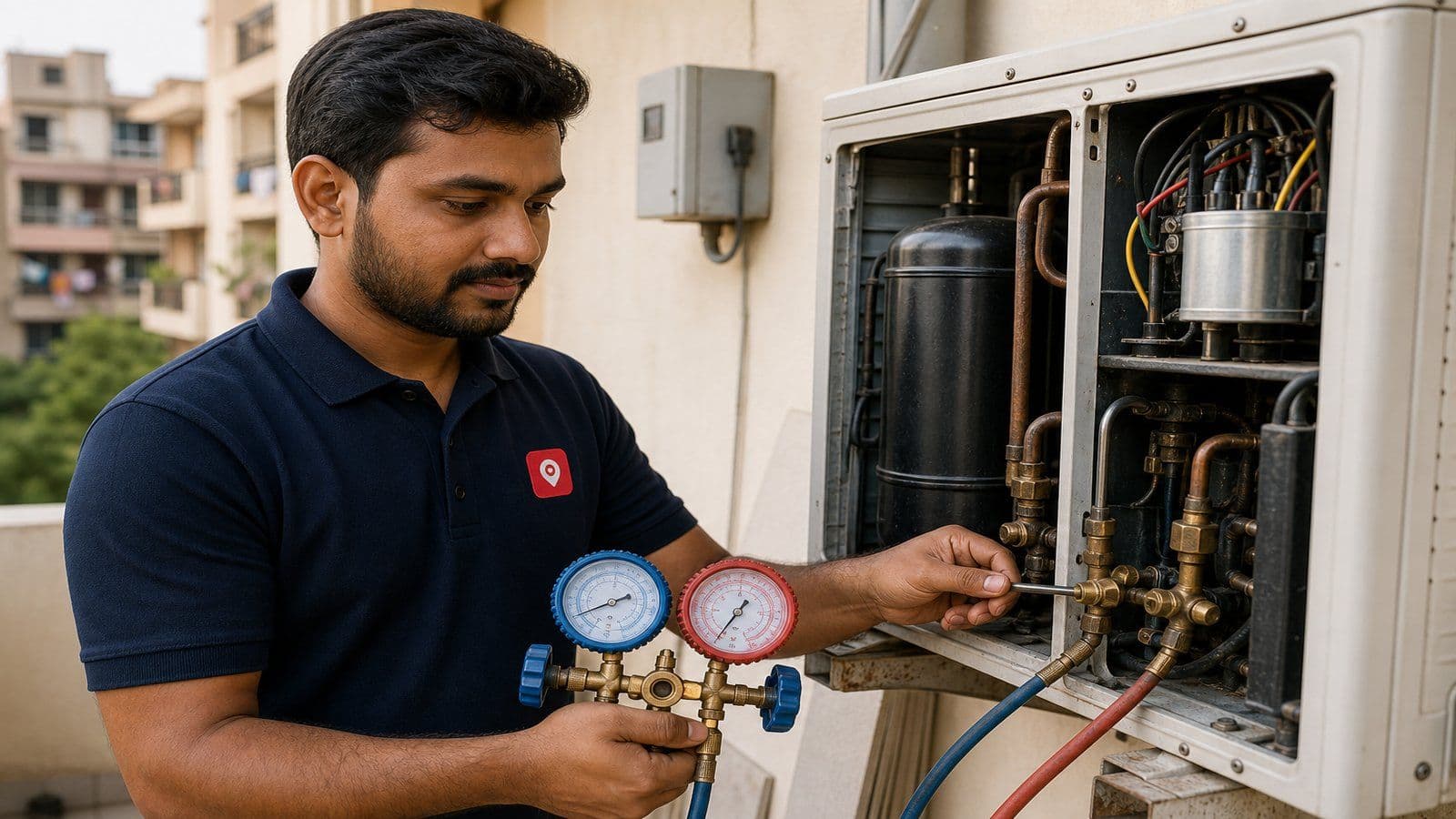
Amit worked as an AC technician for 6 years in Ahmedabad before transitioning to technical writing. He holds a diploma in Refrigeration and Air Conditioning from ITI Ahmedabad and understands the difference between what AC companies promise and what actually happens on the ground. His articles break down complex technical topics into plain language that any homeowner can follow. He tests every tip he writes about in his own home first.

Dr. Verma is a mechanical engineer with 15 years of experience in HVAC systems. She completed her PhD from IIT Delhi on energy-efficient cooling solutions for Indian residential buildings. She reviews all technical content on HomePros to make sure the numbers are right, the advice is safe, and the recommendations are backed by actual engineering principles. She consults for multiple AC manufacturers on product design.